
Learning a new language is not about enduring confusion, stress or fear.
It is about being understood, supported and guided toward real communication. This is especially important for children, beginners and learners who are adapting to a new educational, social or cultural environment. In these situations, language learning is not just an academic task. It is connected to confidence, participation, identity and access to everyday life.
At INDORA, we believe that adaptation in language learning is not a weakness. It is a professional responsibility.
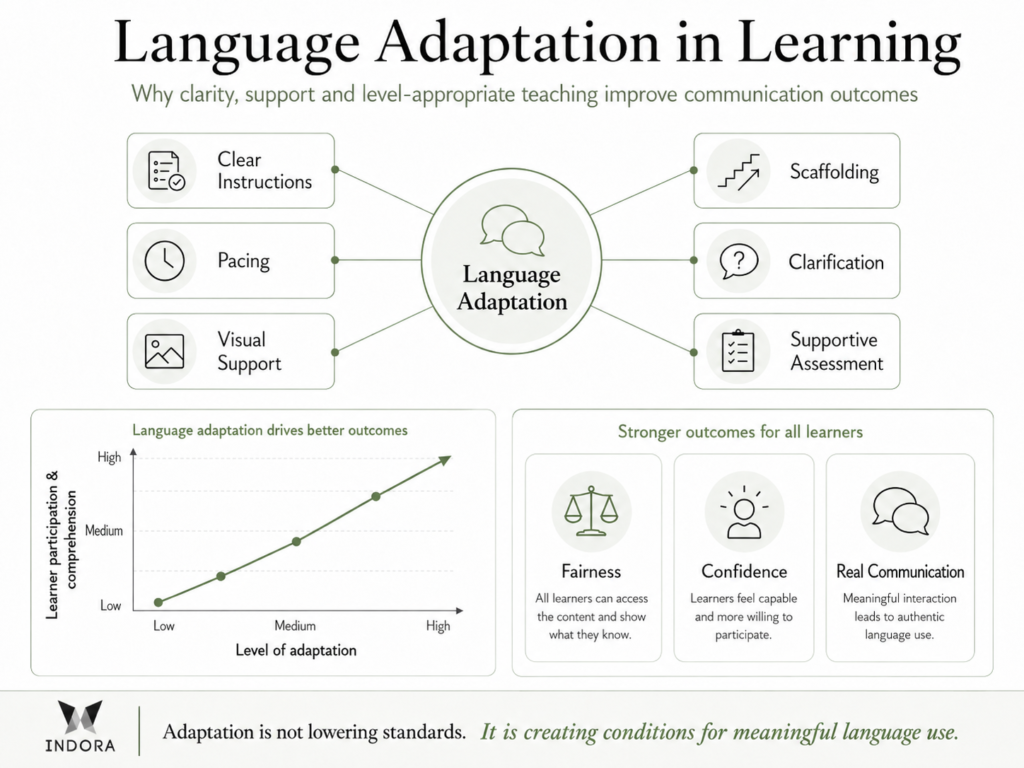
Adaptation does not mean lowering standards
One of the biggest misunderstandings about adaptation is the idea that it makes learning less serious. In reality, adaptation does not mean reducing expectations or avoiding challenge. It means making sure that the learning task matches the learner’s age, level, context and actual capacity to respond.
A beginner learner should not be expected to understand complex instructions before they have the language tools to do so. A child should not be assessed through tasks designed for older learners. A learner who is still building basic vocabulary should not be judged as if they were already independent in the language. Good adaptation keeps the learning goal clear, but adjusts the path toward it. The standard remains meaningful communication. The method becomes more accessible.
Why beginner learners need clarity
At beginner levels, especially A1, learners are still building the foundations of communication. They are learning how to understand simple messages, respond to familiar questions, use everyday words and participate in short interactions. At this stage, even small barriers can block learning: unclear instructions, fast speech, unfamiliar formats, abstract vocabulary or too much pressure.
For an A1 learner, the problem is not always the language content itself. Sometimes the problem is the way the task is presented.
This is why beginner learners need:
– clear and simple instructions;
– familiar examples before a task begins;
– visual or contextual support;
– enough time to process and respond;
– the possibility to ask for clarification;
– evaluation methods that focus on communication, not anxiety.
These are not “extra help” in a weak sense. They are part of effective language teaching.
The difference between challenge and overload
Language learning should include challenge. Learners need to be encouraged to try, practise and move beyond what they already know.
But challenge is not the same as overload.
A useful challenge helps the learner grow. Overload blocks the learner’s ability to think, understand and respond. When a task is too unclear, too fast or too emotionally stressful, learners may stop showing what they actually know.
This is especially visible in oral communication.
A learner may remain silent not because they know nothing, but because they are afraid of making mistakes. A child may answer incorrectly not because they did not learn, but because they did not understand the instruction. An adult may avoid speaking not because they are not interested, but because the situation feels unsafe or humiliating.
In these cases, the assessment is no longer measuring language competence clearly. It is also measuring stress, fear or confusion.

Evaluation should measure communication, not anxiety
Assessment is one of the areas where adaptation matters most.
A good language evaluation should help us understand what the learner can actually do with language. Can they understand a simple message? Can they respond to a familiar question? Can they ask for help? Can they use words and phrases in a meaningful situation?
If the evaluation creates unnecessary anxiety, the result may be misleading.
Supportive evaluation does not mean giving everyone the same result. It means giving every learner a fair opportunity to show their real level.
For beginners and children, this may mean using simple wording, repeating instructions, giving examples, allowing short answers, using familiar topics and focusing on the communicative goal rather than perfect form.
The purpose of evaluation should not be to expose failure.
It should show progress and guide the next step.
Adaptation is especially important for children
Children who learn a new language are not only developing vocabulary and grammar. They are also developing confidence, emotional regulation, social belonging and trust in the learning environment.
If learning becomes associated with shame, fear or repeated failure, children may withdraw. They may stop trying, avoid speaking or believe that they are “bad” at learning.
This can affect much more than one course or one test.
A supportive language environment helps children take risks safely. It allows them to make mistakes without feeling humiliated. It helps them understand that learning a language is a gradual process, not a performance of perfection.
For children, adaptation is not optional. It is part of protecting the learning process.
Adaptation supports fairness
Fairness in education does not always mean treating every learner in exactly the same way.
Learners have different starting points. Some have strong literacy skills in their first language. Others may have interrupted education. Some understand more than they can say. Others can speak informally but struggle with reading or writing. Some learners are confident; others are anxious or afraid of authority.
A fair language learning environment recognises these differences.
Adaptation helps separate the learner’s actual language ability from barriers that are not part of the skill being assessed.
If the goal is communication, then the learning and evaluation methods should make communication possible.
Language learning is part of inclusion
Language is not only a school subject.
It is how people ask for help, understand information, speak to institutions, support their children, access services, look for work, build relationships and participate in community life.
This is why language education has a strong social dimension.
When language learning is clear and supportive, it opens doors. When it is confusing, rigid or intimidating, it can create new barriers.
For migrants, refugees, newcomers, children, adults and anyone learning in a vulnerable moment of life, language can become a bridge toward autonomy and participation.
But that bridge must be built carefully.
What we believe at INDORA
We believe that language education should be practical, fair and human.
This means designing learning experiences that are adapted to the learner’s level, age and context. It means using clear instructions, supportive evaluation and real-life communication tasks. It means understanding that confidence is not separate from learning. It is part of learning.
We believe that:
-adaptation ensures fairness;
-clarity builds confidence;
-supportive evaluation leads to real learning;
-communication matters more than performance under stress;
-language education should open doors, not create barriers.
Conclusion
Adaptation in language learning is not a shortcut.
It is the condition that allows real learning to happen.
When learners understand what is expected from them, they participate more. When they feel safe enough to try, they communicate more. When evaluation is clear and supportive, teachers can see real progress. When language learning is connected to everyday life, it becomes meaningful.
Integration does not begin with pressure.
It begins with understanding — on both sides.