
A foreign worker in a warehouse does not need exactly the same Romanian language practice as a person working in a hotel, a construction site, a restaurant, a factory or a care setting. They may all be beginners. They may all need Romanian for everyday life and employment. But the situations in which language becomes urgent, useful or even protective are different.
This is why Romanian language courses for foreign workers should not be designed as one generic programme built around vocabulary lists and grammar exercises alone. A meaningful course needs a clear educational framework, but it must also reflect the real working and living situations of learners.
The Common European Framework of Reference for Languages, commonly known as the CEFR, offers precisely this foundation. Developed by the Council of Europe, the CEFR provides a transparent basis for designing language curricula, learning materials and assessment. Its updated Companion Volume places particular emphasis on the learner as a social agent, on action-oriented learning, mediation, online interaction and plurilingual competence.
For Romanian language education addressed to foreign workers, this means a simple but important shift: learners should not only study the language. They should learn to use Romanian to act, communicate, solve problems and participate more safely and independently in their everyday lives.
What CEFR Means in Practice
CEFR is often associated with levels such as A1, A2, B1 or B2. These levels are important, because they make progress easier to describe and learning outcomes easier to organise. Yet the real value of CEFR is not simply in assigning a level to a learner.
At its core, CEFR asks what a person can do with language. Can the learner understand a basic workplace instruction? Can they ask for clarification? Can they explain that a machine is not working correctly? Can they read a shift schedule, understand a short message from an employer or describe a health problem at a pharmacy?
The CEFR Companion Volume describes language use through activities such as reception, production, interaction and mediation. It also recognises that people use language in personal, public, educational and occupational contexts. This makes it particularly relevant for foreign workers, whose learning needs often cross all of these areas in the same day: the workplace in the morning, public transport after the shift, shopping in the evening and a message from a landlord or institution on the phone.
A CEFR-based Romanian course for foreign workers should therefore build practical communication progressively. At beginner level, this may mean understanding basic safety words, introducing oneself, recognising numbers, following simple instructions or asking for help. At higher levels, it may mean discussing a work schedule, explaining a problem, understanding written procedures, participating in training or communicating more confidently with institutions and service providers.
The Same CEFR Level Does Not Mean the Same Curriculum for Everyone
Two learners may both be at A1 level and still require very different learning materials. A worker in construction may urgently need to understand warnings, tools, protective equipment and instructions related to physical safety. A hotel employee may need language for greeting guests, understanding room numbers, responding to simple requests and reporting a maintenance issue. A factory worker may need to understand production steps, quality checks, break schedules and instructions related to equipment.
This does not mean creating a completely different language system for every profession. Romanian grammar does not change from one workplace to another. Basic communication remains important for everyone: greetings, numbers, time, directions, health, transport, documents and everyday services.
What changes is the context in which learners practise the language. Curriculum adaptation means that the same CEFR competence can be developed through situations that are relevant to the learner’s daily reality.
For example, an A1 learner may practise understanding simple instructions. In a construction-related course, those instructions may include putting on protective equipment, stopping an activity or moving materials safely. In a hospitality course, the same language function may be practised through preparing a room, cleaning an area or responding to a basic guest request. In logistics, it may involve locating a parcel, checking a label or reporting a missing item.
The language level is the same. The usefulness of the course becomes much greater because the learning situation is real.

Romanian for Construction and Technical Work
In construction, installation, maintenance and other technical occupations, language can be directly connected to safety. Workers may need to understand instructions given quickly, recognise danger signs, identify tools and materials, respond to emergencies or report that a task cannot be completed safely.
A CEFR-aligned curriculum for beginners in this sector should begin with communication that can be used immediately. Learners need to recognise words related to protection, warning, movement, location, tools, materials and urgent action. They should practise short exchanges with a supervisor or colleague, such as confirming an instruction, asking someone to repeat, explaining that they do not understand or reporting an injury.
At A2 level, the course can move toward describing simple work procedures, reading short instructions, understanding basic scheduling information and communicating about equipment or workplace conditions. At B1 level, learners may be prepared to follow more detailed explanations, participate in workplace training or describe an incident in a clearer and more organised way.
The objective is not to turn a language course into technical certification. It is to help workers communicate more safely and independently within their professional environment.
Romanian for Manufacturing, Warehousing and Logistics
Factories, warehouses and logistics centres often depend on routines, labels, scanning procedures, time schedules, movement instructions and quality requirements. A worker may need to know where an item belongs, whether a product is damaged, when a delivery arrives, which shift applies or how to report a problem on a production line.
In this context, a generic lesson about shopping or hobbies is not enough. A relevant beginner course should include numbers, quantities, colours, locations, basic commands, time expressions, packaging vocabulary and short workplace dialogues. Learners should practise understanding a label, locating an object, checking an order, following a simple procedure or asking what to do next.
As learners progress, they can work with short written messages, digital instructions, simple forms and workplace announcements. The updated CEFR’s attention to online interaction is especially useful here, because many workers now receive schedules, instructions and administrative messages through mobile applications or messaging platforms.
A course that integrates these realities does more than teach vocabulary. It helps foreign workers understand the communication systems already shaping their working day.
Romanian for Hospitality, Cleaning and Food Services
In hotels, restaurants, kitchens, cleaning services and catering, workers often interact with several groups of people: supervisors, colleagues, customers or guests. Communication may need to be polite, quick and practical.
A worker in housekeeping may need to understand room numbers, cleaning instructions, requests for towels, missing objects or maintenance problems. A kitchen worker may need vocabulary related to ingredients, hygiene, equipment, timing and safety. A waiter or service employee may need to greet people, understand simple orders, respond politely or request support from a colleague.
For these sectors, a CEFR-based curriculum should place strong emphasis on interaction. At beginner level, learners benefit from short, repeatable exchanges that resemble real conversations. Rather than studying language only through isolated exercises, they should practise situations such as receiving an instruction, responding to a request, apologising politely, asking for clarification or explaining that a task has been completed.
At more advanced stages, learners may practise handling complaints, explaining options, coordinating tasks or speaking more confidently with customers and managers.
This type of course also supports dignity at work. When a worker can speak directly, rather than remain silent or depend continuously on translation, they can participate more fully in the workplace.
Romanian for Care Work and Personal Support Services
Care work involves a particularly sensitive type of communication. People working with children, older persons, people with disabilities or individuals needing support are not only completing tasks. They are communicating with people who may be vulnerable, anxious, ill or dependent on reliable assistance.
A Romanian language curriculum for foreign workers in care settings must therefore combine practical vocabulary with respectful communication. Learners may need to understand daily routines, food, hygiene, medication reminders, pain, discomfort, emotions, time, appointments and emergency situations. They also need language for reassurance, consent, privacy and polite interaction.
At beginner levels, the focus may be on understanding simple needs and responding appropriately. At later levels, workers may need to describe observations, report concerns, speak with family members or communicate with professionals.
The CEFR concept of mediation is especially valuable in this area. Mediation is not limited to translation. It includes helping another person understand information, facilitating communication and making meaning accessible in a particular situation. The Companion Volume explicitly extends CEFR descriptors in this direction, which makes the framework highly relevant for workers whose professional role depends on care, explanation and trust.
Romanian for Delivery, Retail and Customer-Facing Work
Foreign workers in delivery services, shops, markets and other customer-facing roles may need to interact with the public from the beginning of their employment. They may need to confirm an address, explain a delay, understand a payment method, respond to a customer question or manage a short problem politely.
A practical curriculum for these roles should include addresses, directions, numbers, payments, telephone interaction, digital messages and courteous forms of communication. Learners may practise how to call a customer, ask for a location, explain that they have arrived, confirm an order or request assistance.
These situations also show why digital competence and language learning increasingly overlap. A worker may understand basic spoken Romanian but still struggle with a written instruction in an application, an automated message or an online form. Language education for contemporary work should therefore include realistic digital communication, especially from A2 level onward.
Everyday Life Must Remain Part of Every Industry-Specific Course
Although professional adaptation is important, foreign workers cannot be reduced to their job roles. A person working in a factory still needs to visit a doctor. A construction worker may need to understand a rental contract. A hotel employee may need to speak to a child’s teacher. A delivery worker may need to open a bank account or communicate with immigration services.
A strong curriculum should therefore have two connected dimensions. The first is common to all foreign workers and focuses on life in Romania: transport, health, shopping, accommodation, emergencies, appointments, documents, banking and basic institutional communication. The second is adapted to the learner’s employment sector and develops the language required for specific tasks, interactions and risks.
This combination is more respectful and more effective. It recognises workers as whole people, with professional responsibilities and personal lives, rather than teaching only the language needed for immediate productivity.
Plurilingual Support Is Not a Weakness
Foreign workers may begin Romanian language courses with very different linguistic backgrounds. Some may speak English. Others may rely more comfortably on Arabic, Nepali, Tamil, Bengali, Sinhala, Vietnamese, Turkish, Ukrainian or another language. Some may have extensive formal education, while others may learn more effectively through oral practice and visual examples.
A CEFR-informed programme does not require learners to abandon the languages they already know. The Companion Volume recognises plurilingual and pluricultural competence as part of meaningful language use. In practical terms, this means that learners’ existing languages can be used strategically to support understanding, safety and faster access to essential communication.
At beginner level, translated key words, multilingual glossaries, audio materials, images and clear scenarios can make an important difference. A learner who immediately understands the meaning of a workplace warning or a medical expression is not learning “less Romanian”. They are being supported to learn Romanian through a safer and more accessible route.
Over time, Romanian can become more central in the course. But at the beginning, especially for workers facing urgent daily communication needs, multilingual support is a bridge, not an obstacle.
Assessment Should Measure What Learners Can Actually Do
A Romanian language programme for foreign workers should not measure progress only through grammar tests or memorised vocabulary. Assessment should reflect the practical outcomes of learning.
At beginner level, a learner may demonstrate progress by understanding a simple safety instruction, introducing themselves, reading a work schedule or asking for help. At A2 level, they may complete a simple form, explain a basic workplace issue, understand a written message or manage a short interaction at a pharmacy. At B1 level, they may describe a problem in more detail, participate in training, understand a longer instruction or communicate more independently with an institution.
This approach follows the CEFR principle of describing what learners can do with language. It also creates more meaningful information for course providers and employers. Attendance alone does not show whether a course has helped a worker become safer, more independent or better able to communicate.
Assessment should remain fair and supportive. It should identify progress and ongoing needs, not punish learners for having arrived in Romania without the local language.
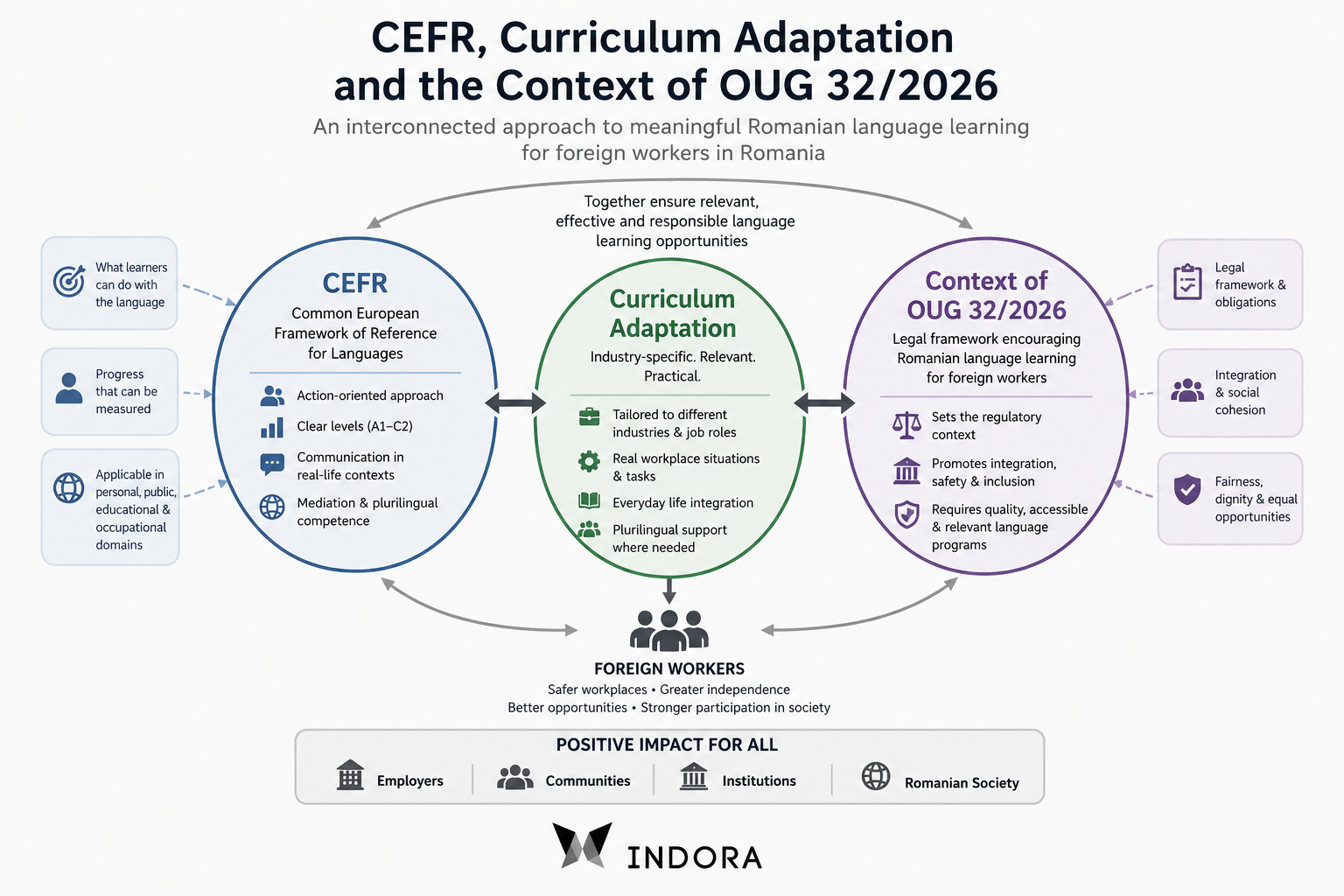
CEFR, Curriculum Adaptation and the Context of OUG 32/2026
In the context of discussions surrounding OUG 32/2026 and Romanian language learning for foreign workers, curriculum quality becomes an essential question. Where Romanian language courses are expected or encouraged in relation to foreign employment, the issue should not be reduced to whether a worker has been enrolled in a programme.
The important question is what kind of programme is being offered. A course that uses the same generic content for every learner, regardless of workplace reality, may be easy to administer but limited in practical impact. A course grounded in CEFR and adapted to different industries can support communication that workers actually need: understanding safety, interacting with colleagues, using services, reading essential documents and participating more confidently in Romanian society.
Specific legal requirements, including any obligations, implementation periods, hours of instruction or documentation connected to OUG 32/2026, should be confirmed from the official legal text and current guidance before being communicated publicly or implemented by employers. The educational principle, however, is clear: language support for foreign workers should be relevant, measurable and connected to real life.
A Language Course Should Create Possibility, Not Just Compliance
For employers, Romanian language learning can be part of safer and more responsible workforce integration. For workers, it can mean greater confidence, reduced dependence and better access to opportunities. For communities, it can support interaction, participation and mutual understanding.
CEFR provides the structure needed to organise learning clearly and evaluate progress responsibly. Curriculum adaptation provides the relevance needed to make learning useful in the real world. Together, they make it possible to design Romanian language courses that respond to the diversity of foreign workers and the industries in which they contribute every day.
At INDORA, we believe that learning Romanian should not be treated as a bureaucratic requirement separated from people’s lives. A language course should help a construction worker understand a safety instruction, a care worker reassure an older person, a hospitality employee communicate confidently, a factory worker report a problem and any foreign worker manage everyday life with greater independence.
Because language is not only about words. It is about access, safety, dignity and the ability to take part in one’s own future in Romania.