Estimated reading time: 4 minutes
Learning Romanian as a foreign worker is not the same experience for everyone. A lot depends on your first language. The alphabet you grew up with, the sounds you already use, whether your language has tones, and how your sentences are built all change which parts of Romanian feel easy and which take more practice.
That is good news. It means Romanian is never a single wall you either climb or fail. It is a set of small steps, and some of those steps are already familiar to you because of the language you speak.
Below is a short guide by nationality. Find your language, see what works in your favour, and start from there. Whatever your background, the goal in your first months is the same: not perfect Romanian, but useful Romanian — enough to stay safe, ask questions and feel less dependent at work and in daily life.
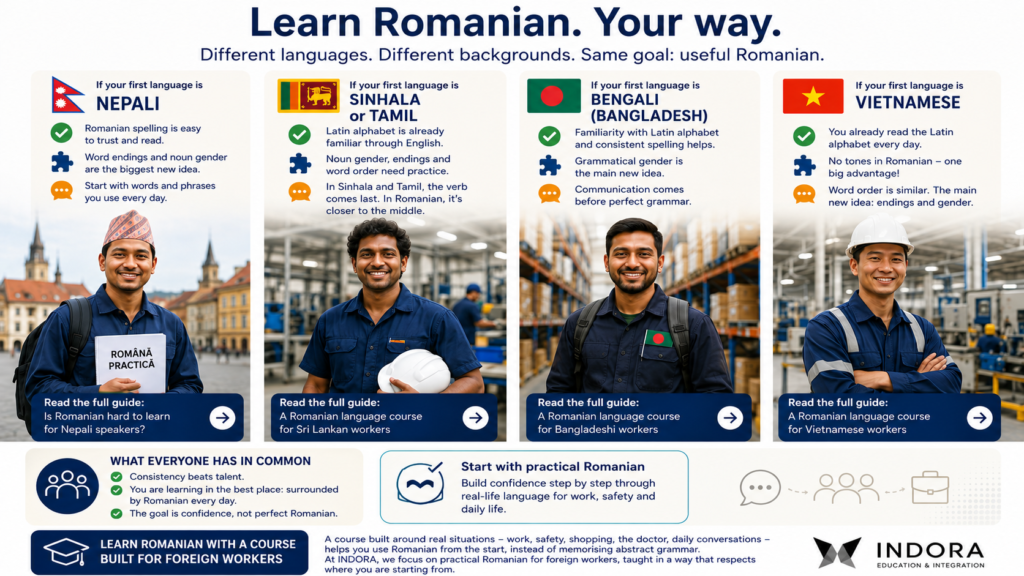
If your first language is Nepali
Nepali speakers are used to a different script, but Romanian’s consistent, “read-it-as-you-see-it” spelling makes the Latin alphabet easier to trust. The hardest new idea is usually word endings and noun gender, which work differently from Nepali. Start with everyday words and short phrases, and let grammar grow with use.
Read the full guide: Is Romanian hard to learn for Nepali speakers?
If your first language is Sinhala or Tamil (Sri Lanka)
For Sri Lankan workers, the Latin alphabet is already familiar through English, and Romanian’s predictable spelling makes reading easier than it looks. The biggest adjustments are noun gender, word endings, and word order — in Sinhala and Tamil the verb usually comes last, while in Romanian it sits closer to the middle.
Read the full guide: A Romanian language course for Sri Lankan workers
If your first language is Bengali (Bangladesh)
Bangladeshi workers benefit from familiarity with the Latin alphabet through English and from Romanian’s consistent spelling. The most new idea is grammatical gender: Bengali does not mark gender the way Romanian does, so masculine, feminine and neuter nouns take some getting used to. As always, communication comes before perfect grammar.
Read the full guide: A Romanian language course for Bangladeshi workers
If your first language is Vietnamese
Vietnamese speakers have two clear advantages: you already read the Latin alphabet every day, and Romanian has no tones, so one whole layer of difficulty disappears. The basic word order is also familiar. The main new idea is that Romanian words change their endings and have gender, while Vietnamese words stay the same.
Read the full guide: A Romanian language course for Vietnamese workers
If your first language is English (Nigeria)
Nigerian workers start with a real head start: English is an official language in Nigeria, and it shares the Latin alphabet and many Latin- and French-based words with Romanian. Your English helps you read, recognise familiar words and ask for help while you learn. The main new idea is grammatical gender and the way Romanian words change their endings — something English does not really do.
Read the full guide: A Romanian language course for Nigerian workers
What everyone has in common
No matter where you come from, a few things are true for every learner.
Consistency beats talent. Ten or fifteen minutes a day, connected to real situations, works better than long sessions you forget by the next week. You are also learning in the best possible place — surrounded by Romanian every day, where every shift is practice. And you do not need to be fluent in six months. The realistic goal is confidence: understanding and using Romanian in the situations that matter for your work and daily life.
New in Romania? Start with the basics.
Download a short guide with practical Romanian phrases and first-month tips for foreign workers.
Learn Romanian with a course built for foreign workers
Whatever your first language, what makes the real difference is the kind of course you follow. A course built around real situations — work, safety, shopping, the doctor, daily conversations — helps you use Romanian from the start, instead of memorising abstract grammar.
At INDORA, we focus on practical Romanian for foreign workers, taught in a way that respects where you are starting from. Our work is shaped by direct experience with migrant and newcomer communities, so we understand the real barriers — and how to get past them step by step.
Read more about our online Romanian language course for foreign workers in Romania. We are here to support you.