Summary: When you work in Romania, you sign an individual employment contract (in Romanian, “contract individual de muncă”, or CIM). It must be written in a language you understand, not only in Romanian. It states your job, your workplace, your working hours and your salary. Your salary is shown as “gross” (before taxes) and “net” (what you actually receive). Three contributions are taken from your gross salary: pension (CAS, 25%), health (CASS, 10%) and income tax (10%). Your salary must be paid into your bank account. This guide explains every part in plain language.
Starting a job in a new country is stressful enough without a contract full of unfamiliar words. This guide walks you through what a Romanian employment contract contains, what the taxes mean, the difference between gross and net salary, how you get paid, and what a “pontaj” is.
What is an employment contract in Romania?
The individual employment contract (CIM) is the written agreement between you and your employer. By law, it must exist in writing before you start work, and you must receive a copy. For foreign workers, an important rule applies: under Government Emergency Ordinance 32/2026, the contract must be drawn up both in Romanian and in your own language or an international language you understand. You should never sign a contract you cannot read. If it is only in Romanian, ask for a translated version.
What clauses does the contract contain?
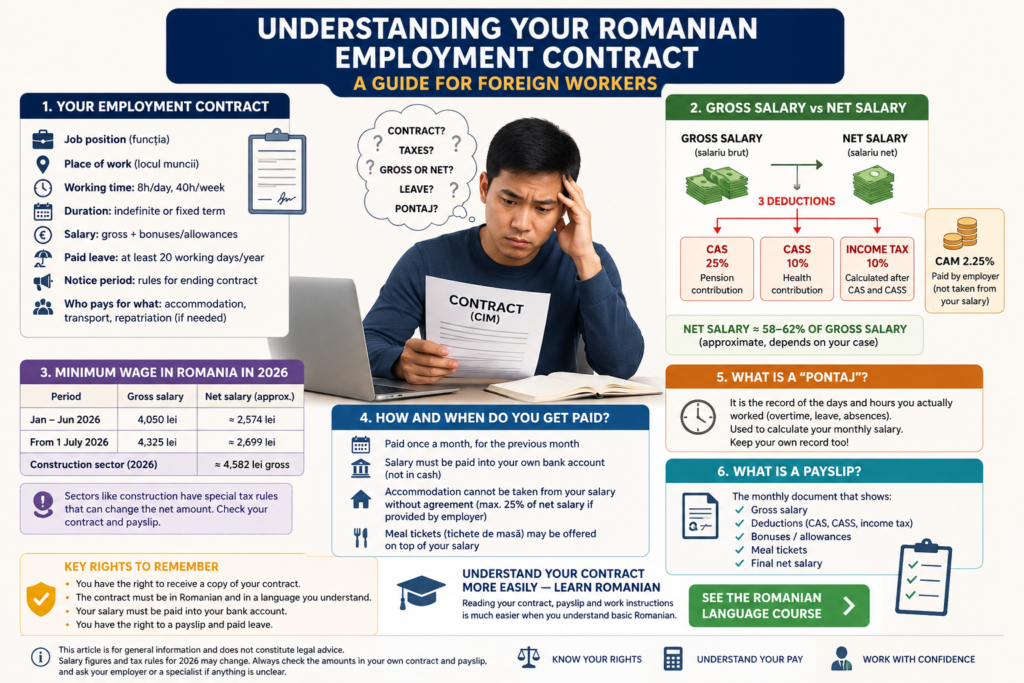
A Romanian employment contract includes a standard set of elements. Here is what to look for:
- The parties: your full name and details, and the employer’s company name and registration details.
- The job position (funcția): your job title and a code from the Romanian classification of occupations (COR). You should only do the work described here.
- The place of work (locul muncii): where you will work. If the work can be in several locations, it should say so.
- Working time: a full-time job in Romania is normally 8 hours a day, 40 hours a week. Overtime and night work have separate rules.
- Duration: the contract can be for an indefinite period (“nedeterminată”) or for a fixed term (“determinată”).
- Salary: the gross amount, plus any bonuses or allowances (“sporuri”).
- Paid leave (concediu): the number of paid holiday days per year (at least 20 working days for full-time).
- Notice period: how much warning either side must give to end the contract.
- Who pays for what: for foreign workers, the contract should state who covers costs such as accommodation, transport or, if needed, repatriation.
Gross salary vs net salary: what is the difference?
This is the part that confuses most people. Your contract usually shows the gross salary (“salariu brut”) — the full amount before any deductions. The net salary (“salariu net”) is what actually arrives in your bank account after taxes. The net is always lower than the gross. This is normal and legal; it is the same for Romanian and foreign workers.
Three deductions are taken from your gross salary:
- CAS — pension contribution (25%): goes to the public pension system. It builds your future pension rights.
- CASS — health contribution (10%): goes to the public health system and gives you access to public medical services.
- Income tax (10%): calculated after the pension and health contributions are subtracted.
There is also a small employer contribution called CAM (2.25%), but this is paid by the company on top of your salary — it is not taken from your pay.
As a rough guide, for most salaries the net is around 58–62% of the gross. So if your contract says a gross salary, expect to receive a bit more than half of it in your account. The exact figure depends on deductions that apply in your case.
What is the minimum wage in Romania in 2026?
For 2026, the national minimum gross wage is 4,050 lei per month from January to June, and 4,325 lei per month from 1 July. This corresponds to a net of roughly 2,574 lei and 2,699 lei respectively. In the construction sector, the minimum is higher (around 4,582 lei gross). These figures change over time, so always check the amount written in your own contract and on your payslip.
Note: some sectors, such as construction, have special tax rules that can change the net amount. If you work in such a sector, your payslip may look different. Ask your employer or HR if something is unclear.
How and when do you get paid?
Salaries in Romania are normally paid once a month, for the previous month’s work. For foreign workers, the law requires that your salary be paid into your own bank account — not in cash. This protects you: there is a clear record of what you were paid. You will usually need to open a Romanian bank account in your name. The rent for your accommodation cannot simply be taken from your salary without your agreement, and if the employer provides accommodation, the amount withheld is capped at 25% of your net salary.
Some employers also offer meal tickets (“tichete de masă”), up to a set value per worked day. These are added on top of your salary.
What is a “pontaj”?
A “pontaj” is the attendance and working-time record — like a timesheet. It records the days and hours you actually worked, including overtime, leave and absences. The employer keeps it, and it is the basis for calculating your salary for the month. If you believe your salary does not match the hours you worked, the pontaj is the document to check. It is good practice to keep your own simple note of the days and hours you work.
What is a payslip (“fluturaș de salariu”)?
The payslip is the monthly document that shows how your net salary was calculated: the gross amount, each deduction (CAS, CASS, income tax), any bonuses, meal tickets, and the final net you receive. You have the right to receive it. Reading it becomes much easier once you know the words above: brut, net, CAS, CASS, impozit.
Understand your contract more easily — learn Romanian
Reading your contract, your payslip and your work instructions is much easier when you understand basic Romanian. INDORA’s online Romanian course is built for foreign workers, with practical language for work and daily life.
Frequently asked questions
Why is my net salary lower than the gross salary in my contract?
Because three contributions are taken from the gross amount: pension (CAS, 25%), health (CASS, 10%) and income tax (10%). The net salary is what remains after these. This is normal and the same for all workers in Romania.
Does my employment contract have to be in a language I understand?
Yes. Under OUG 32/2026, the contract for a foreign worker must be in Romanian and in your own language or an international language you understand. Never sign a contract you cannot read.
Can my salary be paid in cash?
No. For foreign workers, the salary must be paid into your own bank account. This creates a clear record of your pay and protects you.
What is the minimum wage in Romania in 2026?
4,050 lei gross per month from January to June 2026, and 4,325 lei from 1 July 2026 (higher in construction). The net is roughly 2,574 to 2,699 lei. Always check the amount in your own contract.
What is a pontaj?
It is the record of the days and hours you actually worked, kept by the employer. It is used to calculate your monthly salary, so it is the document to check if your pay seems wrong.
This article is for general information and does not constitute legal advice. Salary figures and tax rules for 2026 may change. Always check the amounts in your own contract and payslip, and ask your employer or a specialist if anything is unclear.