
In short: Adults do not learn a language “worse” than children, just along a different path. They have real advantages (abstract thinking, experience, strategies, clear motivation) and specific obstacles (little time, tiredness, a working memory that fills up fast, fear of mistakes). Effective adult learning rests on a few principles with solid scientific support: spaced practice over time, active recall, interleaving exercises, material that is understandable but just above the current level, lower anxiety and support for motivation. This guide explains each one in depth, and what a properly built course looks like, especially for migrants and foreign workers learning under pressure.
One of the most widespread beliefs about languages is also one of the most wrong: that after a certain age, “you can no longer learn”. Many adults repeat it as an excuse, and others live it as a sentence. The psychology of learning says something quite different. Adults learn very well, but differently from children, with other strengths, other weaknesses and other methods that work. This article is a full walk through what we know about how adults learn a language, from myths to mechanisms, from memory to emotion, all the way to what a course that genuinely helps them should look like.
Contents
- The “I am too old to learn” myth
- Children and adults: two different paths
- The real advantages of the adult
- The specific obstacles of the adult
- Working memory and cognitive load
- Spaced practice: why “little and often” wins
- Active recall: remembering is learning
- Interleaving: why to mix rather than block
- Comprehensible material: neither too easy nor too hard
- Emotion and the affective filter
- Motivation: what fuels it and what kills it
- Relevance and the principles of adult education
- Speaking and the role of active output
- Mistakes and feedback: correcting without blocking
- How vocabulary sticks in memory
- Routine and consistency: the quiet engine
- Special considerations for migrants
- What a properly built course looks like
- Practical tips for the learner
- Frequently asked questions
The “I am too old to learn” myth
Let us begin with the myth, because it stops most adults before they even try. The idea that there is an age after which the brain “closes” for languages comes from an exaggerated reading of a real observation: young children who grow up in a language usually reach a pronunciation and fluency that adults achieve less often. This gave rise to the concept of a “critical period”.
But today’s research strongly qualifies this idea. First, the “critical period” seems to affect mainly the native accent, not the ability to learn and use a language effectively. Adults can reach very high levels of competence; what often remains different is a slight accent, which does not get in the way of communication at all. Second, many of the apparent advantages of children come not from the brain but from context: the child is exposed dozens of hours a week, without shame, without the pressure of not making mistakes, without a job and a family to support. Give an adult the same conditions and their progress can be remarkable.
The honest conclusion: age is not the wall we think it is. The adult is not a child who missed the train, but a different kind of learner, with a different set of tools. The rest of this article is about how you use those tools.
Children and adults: two different paths
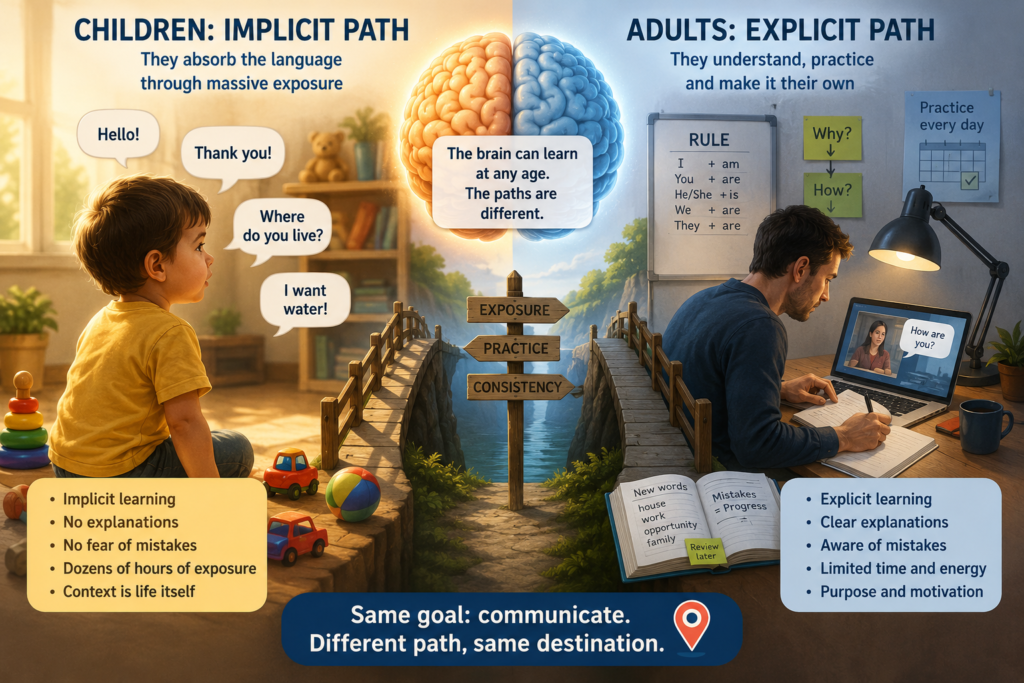
The key difference lies in how each one processes language. The young child learns largely implicitly: they absorb patterns from massive exposure, without realising they are learning rules. They cannot explain why they say something a certain way; it simply “sounds right”. This kind of learning is slow, but deep and very stable.
The adult learns largely explicitly: they want to understand the rule, the logic, the structure. When they hear a new construction, their mind immediately looks for the “why” and “how it fits with what I know”. This way of learning is faster at the start, because the adult can apply a rule as soon as they understand it, but it needs practice to become automatic, that is, to move from “I know the rule” to “I use it without thinking”.
A good course for adults uses this difference rather than ignoring it. It offers clear explanations (for the mind that wants to understand), but combines them with plenty of real practice (so the rule becomes a reflex). Teaching an adult like a child, only through exposure without explanation, wastes their great advantage. Teaching them only rules, without practice, leaves them with a head full of theory they cannot use.
The real advantages of the adult
Adults start with a set of advantages a child does not have. They are worth listing, because each can be used deliberately.
- Abstract thinking: the adult can understand grammatical concepts, compare structures and generalise a rule to new situations. They can consciously learn something a child only picks up after years of exposure.
- The first language as a bridge: the adult already knows the fundamental concepts of language. They know what the past tense, possession, a question and negation are. They do not learn these ideas from scratch, only how the new language expresses them. This transfer greatly accelerates learning.
- Formed learning strategies: an adult already knows, from experience, how to take notes, organise their time, look up a word and check their understanding. These so-called metacognitive strategies are a huge advantage.
- Clear motivation: the adult usually learns for a concrete and pressing purpose: work, family, survival, dignity. This motivation, when properly supported, is a powerful fuel.
- The ability to direct attention: unlike a child, an adult can consciously decide to focus on something difficult and persist, even when it is not fun.
None of these advantages works on its own. But together, they mean that a motivated adult, with a good method and protected time, can make progress they themselves did not believe possible.
The specific obstacles of the adult
Being honest about advantages means being honest about obstacles too. Adults run into real barriers, and a good course takes them into account rather than pretending they do not exist.
- Time: the adult has a job, a family, obligations. They cannot dedicate dozens of hours a week. Any method that demands a lot of time is, in practice, a method that fails.
- Tiredness: many adults, especially workers, learn after a hard day. A tired brain learns worse. Lessons must be short and must not demand enormous effort.
- Limited working memory: unlike a child who “lets it flow”, the adult processes consciously, and working memory fills up fast. Too much information at once produces a block.
- Fear of making mistakes: an adult has an identity, a status, a self-image. Speaking badly, stumbling, being corrected in public are experiences they feel as humiliation. This fear makes them silent, and silence blocks learning.
- Fossilisation: when a mistake is repeated for a long time without correction, it sets and becomes hard to change. Adults who “get by” can remain stuck at a level with stable errors.
- First-language interference: sometimes structures from the native language “pull” incorrectly into the new language, especially at the beginning.
The good news is that each of these obstacles has a pedagogical answer. The rest of the article goes through the principles that address them directly.
Working memory and cognitive load
To understand why some lessons work and others tire you out with no result, we need to understand working memory. This is the mental space where we hold and process information in the present moment. It has a small capacity: we can handle only a few new items at once. When we give it too much, it blocks, and learning stops.
Cognitive load theory explains a golden rule of teaching adults: introduce one new thing at a time, well structured, and consolidate it before adding another. A lesson that throws in twenty new words, three grammar rules and a complex conversation at the same time is not “rich”, but ineffective: it exceeds processing capacity and most of the information is lost.
Applied in practice, this means short lessons, with clear and few objectives, in which each new element has room to be understood and practised. It looks like “less”, but it produces “more”, because what goes in actually stays. For an adult tired after work, respecting this principle is not a detail but the difference between learning and struggling for nothing.
Spaced practice: why “little and often” wins
One of the best-confirmed principles in the entire psychology of learning is the spacing effect. Studying one hour a day for six days produces far more durable learning than studying six hours in a single day, even though the total time is identical.
The reason lies in how the brain consolidates memory. Fixing information happens largely during breaks, including during sleep. Each re-encounter with the material, after a pause, strengthens the memory trace and makes it more resistant to forgetting. Study marathons, by contrast, give the illusion of progress on the day, but the information evaporates quickly.
For adults, this news is actually liberating. You do not need large blocks of time that you do not have anyway. You need consistency: fifteen to twenty minutes a day, every day, beat two hours once a week. A good course for adults is designed exactly this way: small, frequent portions, repeated over time, not rare and long sessions.
Active recall: remembering is learning
Here is one of the most counter-intuitive and most powerful principles. Most people believe they learn by re-reading: they run their eyes over a list of words several times and feel that they “know” them. But this feeling of familiarity is deceptive. Re-reading produces recognition, not reproduction.
Real learning comes from the effort of remembering. When you try to pull a word from memory, without having it in front of you, you strongly strengthen that memory trace. This is the testing effect: being asked, remembering, struggling to retrieve the information fixes it far better than re-reading it passively. The slightly harder, but successful, the retrieval, the more durable the learning.
That is why an exercise that makes you produce the answer (a short quiz, a question card, a question you have to answer from memory) is worth more than reading the same text ten times. For adults, who want efficiency in the little time they have, active recall is probably the best investment of effort. A good course builds exercises that make you remember, not just recognise.
Interleaving: why to mix rather than block
Another surprising principle is interleaving. Intuition tells us to practise one thing until we master it, then move to the next (blocked practice). Research shows, however, that mixing several types of problems or structures, rather than grouping them, produces more durable learning and a better ability to choose the right strategy in real life.
The reason is that real life does not come grouped. When you speak a language, you do not get “now only the past tense, then only the future”. You have to choose the right structure on the spot. Interleaving trains exactly this choice. At first it feels harder and more confusing than blocked practice, but this extra effort is precisely what produces more solid learning.
In practice, this means a good course does not keep you for weeks on a single type of exercise, but mixes vocabulary, structures and situations, returning to old ones while introducing new ones. The combination of interleaving and spaced practice is especially powerful.
Comprehensible material: neither too easy nor too hard
An influential idea in language learning is that we progress best when we receive material we understand for the most part, but which also contains a new step, just above our current level. If the material is too easy, we learn nothing new. If it is too hard, we get lost and discouraged. The sweet spot is “understandable, plus one step”.
For adults, this principle has an important practical consequence: level matters enormously. A learner thrown into material that is too advanced freezes and loses confidence; one kept too long at an easy level gets bored and stagnates. That is why an initial level assessment and gradual progression are not bureaucracy but conditions for effective learning.
A good course constantly calibrates difficulty: it provides enough context for you to understand, but always pushes you one step further. And it uses language in a way that makes sense, not isolated lists, because understanding context is what makes material comprehensible in the first place.
Emotion and the affective filter
No cognitive principle works if the person is overwhelmed by fear. Emotional state directly affects learning, and this is especially important for adults and migrants.
The idea of an “affective filter” describes the phenomenon well: when a person is anxious, stressed, embarrassed or feels judged, a kind of mental barrier rises that prevents material from being processed and retained. Part of their already limited mental resources is spent on managing fear, not on learning. The result is that an intelligent but frightened learner progresses more slowly than a relaxed one with the same ability.
From this follows something many wrongly consider a “luxury”: a safe, warm learning environment, free of ridicule, is not a matter of kindness but a technical condition of effective learning. For an adult afraid of looking stupid, for a migrant learning under the stress of a new and uncertain life, emotional safety is, literally, what allows the brain to retain. A teacher or course that normalises mistakes and reduces pressure does not “lower the bar”, but unlocks the real capacity to learn.
Motivation: what fuels it and what kills it
Motivation is not a fixed given, but something that can be nourished or killed. Psychology distinguishes between motivation that comes from within (I learn because I want to, because I enjoy it, because it makes sense to me) and motivation that comes from outside (I learn because I have to, because someone makes me). Both can work, but inner motivation is far more durable.
Research on motivation shows that three things support it: the sense that you have some control over your learning (autonomy), the sense that you are becoming more capable (competence), and the sense that you are connected with others (belonging). A course that gives you small choices, shows you concrete progress and creates a sense of community feeds motivation. One that treats you as a number, shows you no progress and leaves you alone kills it.
For adults learning under pressure, a practical factor is the visibility of progress. When you do not see that you are advancing, motivation collapses. When you do, even small steps, it keeps you in the game. That is why short assessments, clear feedback and marking the milestones reached are not just administrative, but motivational fuel.
Relevance and the principles of adult education
Adults do not learn the same way as pupils in a classroom. Adult education has its own principles, long observed in practice. Adults want to understand why they are learning something, want learning to be tied to their real problems, bring life experience that must be respected and used, and are oriented toward solving concrete situations rather than abstract accumulation.
The direct consequence is the principle of immediate relevance. An adult retains far better what they can use today or tomorrow. Vocabulary from the workplace, phrases from the doctor, sentences from the shop or the town hall have a sticking power that abstract lists do not, because they are tied to a real need and an immediate use.
That is why an effective course for adults, especially for foreign workers, starts from real life and work situations, not from pure grammar. Grammar does not disappear, but it is put in the service of real communication, learned through use rather than memorised in a vacuum. Learning based on concrete tasks (how I ask for something, how I understand an instruction, how I introduce myself) suits adults far better than theoretical lessons cut off from life.
Speaking and the role of active output
Many learners believe they will speak “when they are ready”, after they have accumulated enough theory. In reality, producing language, that is, speaking and writing, is not just the result of learning but part of its engine. When you try to say something, you discover exactly what you do not yet know, you activate your knowledge and consolidate it through use.
The effort of producing language forces you to move from passive understanding to active use, and this step is essential. You can understand a lot without being able to speak, but you cannot speak well without practising speaking. That is why postponing speaking “until you feel ready” is often a trap: postponement perpetuates the insecurity.
For adults, the barrier is usually not ability but fear (see the affective filter). A good course creates frequent, safe, low-stakes opportunities to produce language, so that speaking becomes a habit, not a terrifying exam. The earlier and more often you practise, in safe conditions, the faster you cross the threshold.
Mistakes and feedback: correcting without blocking
Mistakes are part of learning, not its opposite. A learner who never makes mistakes is either not being pushed enough or is staying silent out of fear. The problem is not the mistake, but how it is treated.
Effective feedback has a few features. It comes in good time, but does not brutally interrupt every word, because constant correction produces fear and blocks fluency. It is specific and helps the learner understand what to change, not just that they “got it wrong”. And it preserves the person’s dignity, especially for adults, for whom being corrected in public can be humiliating.
There is a delicate balance between letting mistakes set (fossilisation) and correcting so often that you block speaking. A good course finds this balance: it encourages production, corrects intelligently and selectively, and turns mistakes from a source of shame into a normal stage of progress. This climate is itself a condition of effective learning.
How vocabulary sticks in memory
Vocabulary is often the part that scares adults the most: it looks like an endless job of memorising. But here too, the way of learning matters more than raw effort.
Words stick better when they are processed deeply, that is, linked to meaning, images, situations and emotions, not just repeated mechanically. A word learned in a real sentence, tied to a situation you are living, sticks better than the same word from a dry list. Connecting the new word to what you already know, to an image or a personal experience, creates more “hooks” for memory to grab onto.
To this we add the principles already discussed: active recall (remembering the word, not just re-reading it) and spaced practice (re-encountering it over time, at intervals). The combination of deep processing, repeated retrieval and spacing over time is the most effective way to build a durable vocabulary. A good course does not demand blind memorisation, but puts words in context, returns to them over time and makes you produce them.
Routine and consistency: the quiet engine
Beyond any technique, there is a factor that decides who learns and who gives up: consistency. Learning a language is a long project, and progress comes from the accumulation of many small steps, repeated over time. The one who does a little every day gets far; the one who does a lot in rare bursts, followed by long pauses, stagnates.
For adults, the secret is not heroic willpower but habit. A small habit, tied to a fixed moment of the day (ten minutes in the morning, an exercise during the lunch break, a short lesson in the evening), survives far better than the vague intention to “study more”. The habit takes the decision out of the equation: you no longer have to motivate yourself each time, you simply do it.
That is why an effective course for adults is built to encourage routine: small portions, accessible at any time, easy to fit into a busy day. For a foreign worker on shift work, the flexibility to learn at their own pace, but consistently, is often the difference between finishing the course and abandoning it.
Special considerations for migrants
Everything said so far applies to any adult. But migrants and foreign workers learn in conditions that amplify both the obstacles and the stakes. A course that ignores these conditions, however well built pedagogically, will fail in practice.
First, stress. A migrant often learns in the middle of an uncertain life: hard work, homesickness, money sent home, uncertain legal status, isolation. This stress presses directly on the affective filter and on working memory, reducing the capacity to learn. A safe environment and a human tone are not a luxury here but a necessity.
Second, time. Many workers have shift work, long hours, physical exhaustion. Long, rigid courses are incompatible with their lives. They need short, flexible portions, accessible when they can, not a fixed timetable that demands what they do not have.
Third, survival relevance. For a migrant, language is not a hobby but a tool of safety and dignity: to understand an instruction at work, to go to the doctor, not to be cheated, to deal with paperwork. A course that starts from these real needs, with practical vocabulary and concrete situations, does not just teach better but respects the person.
Fourth, the diversity of native languages. A group may contain speakers of very different languages and alphabets. Material built to be accessible regardless of the language of origin, with support in a bridge language such as English, allows people of different nationalities to learn together, without the need for separate groups.
What a properly built course looks like
If we gather all the principles above, the portrait of an effective course for adults, especially for migrants, becomes clear and concrete:
- short, frequent lessons, not long, rare sessions (spaced practice);
- one new concept at a time, well structured (reduced cognitive load);
- many exercises that make you remember, not just re-read (active recall);
- mixing structures and returning to old ones (interleaving);
- material calibrated to your level, with one step above (comprehensible input);
- vocabulary and situations from real life and work (immediate relevance);
- frequent, safe opportunities to speak (active output);
- a climate where mistakes are normal and correction is gentle (low affective filter);
- visible progress and clear feedback (sustained motivation);
- flexibility for shift work and tiredness (realistic routine);
- accessibility for speakers of different languages, with a bridge language.
Notice that none of these elements is about “talent” or “intelligence”. They are all about design. A course built on the real way adults learn helps ordinary, busy, tired people retain more in the little time they have. This is, in essence, the difference between a course that merely “delivers content” and one that actually produces learning.
Practical tips for the learner
If you are the one learning, here are the most useful things you can do, drawn directly from the principles above:
- Learn a little every day, not a lot once a week. Consistency beats intensity.
- Test yourself, do not just re-read. Cover the answer and try to remember.
- Tie new words to real situations in your day, not to abstract lists.
- Speak early and often, even with mistakes. Perfect silence gets you nowhere.
- Do not be ashamed of mistakes. They are the sign that you are pushing, not that you are weak.
- Build a fixed habit, tied to a moment of the day, so you do not depend on motivation.
- Track your progress. Seeing the small steps keeps you in the game.
- Be gentle with yourself. You are learning under pressure, and your emotional state matters for memory.
A course built around how adults learn
INDORA’s Romanian course is designed for adults learning under time pressure: short lessons, practical vocabulary for work and daily life, plenty of “remember it” practice, and an environment where mistakes are part of the process.
Frequently asked questions
Is it true that adults learn a language harder than children?
Not harder, just differently. The “critical period” mainly affects the native accent, not the ability to learn and use a language. Adults have real advantages (abstract thinking, experience, motivation) and can reach very high levels with the right methods.
What is the most effective way to learn a language as an adult?
Short, daily practice (spaced), active recall (remembering rather than just re-reading), interleaving exercises, immediately relevant vocabulary, early speaking and an environment without fear of mistakes. All have solid support in research.
How much time per day should I study?
Little and often beats a lot and rarely. Fifteen to twenty minutes a day, consistently, produce more durable learning than one long session once a week, because of how the brain consolidates memory during breaks.
Why do I forget the words I have learned?
Usually because they were re-read rather than actively recalled, and because they were not re-encountered over time. Words stick when you pull them from memory (test yourself), tie them to real situations and meet them again at intervals.
Should I speak from the start or wait until I am ready?
Speak early and often, in safe conditions. Producing language is part of learning, not just its result. Postponing speaking “until you feel ready” perpetuates insecurity; early speaking accelerates progress.
Are mistakes bad for learning?
No. Mistakes are a normal part of the process and the sign that you are pushing. What matters is a climate where mistakes are not punished or ridiculed, and gentle, specific feedback. Fear of mistakes blocks learning more than the mistakes themselves.
Why do emotion and stress matter in language learning?
Because anxiety consumes mental resources that would otherwise go to learning, and raises an “affective filter” that prevents retention. A safe, relaxed environment directly improves memory and progress, especially for migrants learning under stress.
Do “learning styles” actually work?
No. The idea that you are “visual” or “auditory” and learn better when taught in “your style” has not been confirmed by research; it is one of the most persistent myths in education. What truly works are the principles described in this article, which apply to everyone.
This article presents general principles from the psychology of learning and language teaching, for educational purposes. It synthesises ideas widely accepted in research, but does not replace an individual assessment of learning needs.