
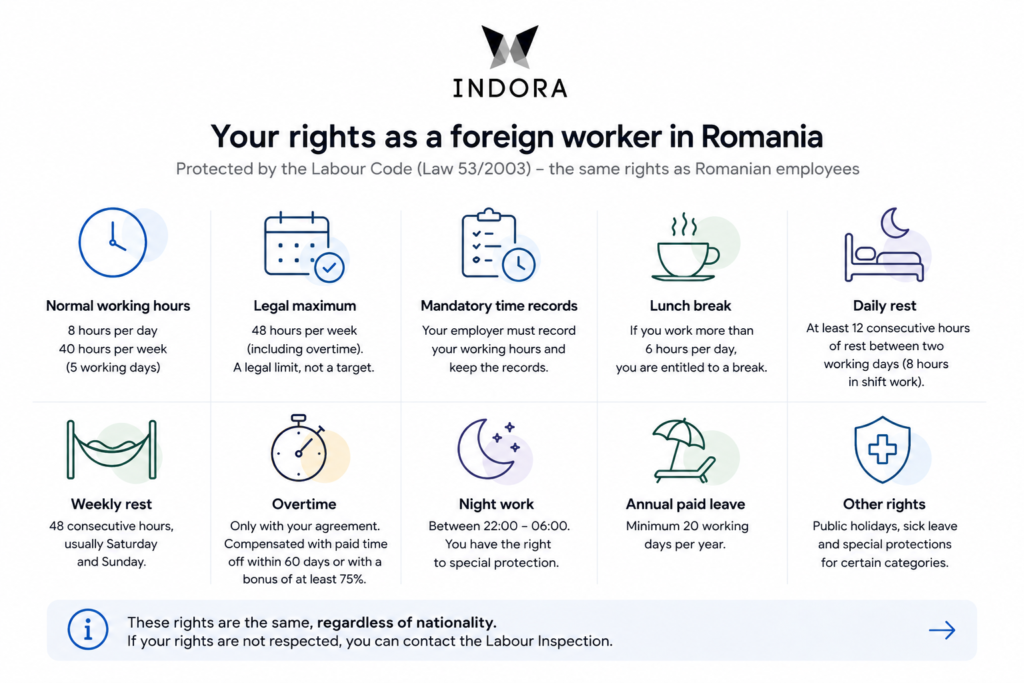
In short: Romanian labour law (Law 53/2003, the Labour Code) applies equally to Romanian and foreign workers. A full-time job means 8 hours per day and 40 hours per week. You are entitled to a lunch break if you work more than 6 hours, at least 12 hours of rest between working days, 48 consecutive hours of weekly rest (usually Saturday and Sunday), a minimum of 20 paid holiday days per year, and compensation or time off for any overtime. This guide explains each right in plain language, with the legal basis, so you know exactly what you are entitled to.
If you are a foreign worker in Romania, the Labour Code protects you in the same way it protects a Romanian employee. Your nationality does not reduce your rights. The rules below come directly from the Romanian Labour Code (Codul Muncii, Law 53/2003) and from the Labour Inspection’s own published guidance. Knowing them helps you recognise when something is wrong and gives you the language to raise it.
Contents
- Normal working hours
- The 48-hour weekly maximum
- Your employer must keep records
- Lunch break
- Daily rest between working days
- Weekly rest
- Overtime: rules and compensation
- Night work
- Annual paid leave
- Public holidays
- Sick leave
- Special protections for certain workers
- What to do if your rights are not respected
- Frequently asked questions
Normal working hours
For a full-time employee in Romania, the normal working time is 8 hours per day and 40 hours per week, spread over 5 working days. This is the standard; it is what your contract should say unless you have a part-time arrangement.
The employer may distribute working hours unevenly across the week (for example, longer days and shorter days), but the weekly total must still respect the normal duration. Whatever the schedule, it must be communicated to you and displayed at the workplace. You should not have to guess when you start and when you finish.
The 48-hour weekly maximum
Including overtime, the legal maximum working time is 48 hours per week. This is a ceiling, not a target. No employer can legally require you to work more than 48 hours in a week, except in cases of force majeure or to prevent or deal with the consequences of an accident.
If your working hours regularly exceed 48 hours per week, that is not normal, and it is not legal. It does not matter whether it is “temporary” or whether “everyone does it”. The 48-hour limit is in the law.
Your employer must keep records
The employer is legally required to keep a record of the hours worked by each employee (the “pontaj”, or timesheet). This record must be available for the Labour Inspection whenever requested. If you believe your hours are not being recorded correctly, or if you are working hours that do not appear in any record, that is a problem. It is good practice to keep your own simple note of the hours you work each day.
Lunch break
If your daily working time exceeds 6 hours, you are entitled to a lunch break. The exact duration and timing are set in the applicable collective agreement or in the company’s internal regulation, but the right itself is in the Labour Code. Lunch breaks are not included in the normal working time, meaning they do not count toward your 8 hours.
If you work more than 6 hours and are not given any break at all, that is a violation of the law, not a company policy.
Daily rest between working days
Between two working days, you are entitled to a rest period of at least 12 consecutive hours. If you work in shifts, this minimum rest between shifts may not be shorter than 8 hours.
What this means in practice: if you finish work at 22:00, you cannot legally be required to start again before 06:00 (shift work) or 10:00 (normal schedule). This rest is mandatory, not optional.
Weekly rest
The weekly rest is 48 consecutive hours, usually on Saturday and Sunday. It can be granted on other days if your collective agreement or internal regulation says so, but you must receive 48 hours of uninterrupted rest each week.
In exceptional cases, weekly rest days may be granted cumulatively after a period of continuous work that cannot exceed 14 calendar days. If your weekly rest is granted cumulatively (meaning you work more than 6 days in a row before getting time off), you are entitled to compensation of at least 150% of your basic salary for the period worked without the normal weekly rest.
If you are regularly working 7 days a week with no day off, or if your “day off” is less than 48 hours, something is wrong.
Overtime: rules and compensation
Any work performed outside the normal working time (beyond 8 hours per day or 40 hours per week) is considered overtime. Overtime has clear rules:
- Your consent is needed. Overtime cannot be imposed without your agreement, except in cases of force majeure or to prevent or deal with the consequences of an accident.
- The 48-hour weekly ceiling applies. Even with overtime, total working time may not exceed 48 hours per week.
- Compensation: overtime must be compensated with paid time off within 60 calendar days after it was performed. If paid time off is not possible, the employer must pay you an overtime bonus of at least 75% of your basic salary on top of your normal pay for those hours.
If you are regularly doing overtime but receiving no compensation, no time off and no bonus, your rights are not being respected. Keep a record of the extra hours, because the Labour Code entitles you to compensation for every one of them.
Night work
Night work is any work performed between 22:00 and 06:00. A “night worker” is someone who either works at least 30% of their monthly hours at night or at least 3 hours of their daily working time at night.
Night workers are entitled to one of two benefits:
- a reduced schedule (one hour less per day, without any reduction in salary) for days when they perform at least 3 hours of night work; or
- a night-work bonus of at least 25% of the basic salary.
Pregnant women, women who have recently given birth, and breastfeeding women cannot be required to perform night work.
Annual paid leave
Every employee in Romania, including foreign workers, is entitled to paid annual leave of at least 20 working days. This is the legal minimum; your contract may provide more, but never less. The exact number is written in your individual employment contract.
Important rules about annual leave:
- Public holidays and paid days off are not included in your leave days. They come on top.
- The right to annual leave cannot be waived, transferred or limited. You cannot be asked to give it up.
- Leave must be taken each year. If it was not possible to take it, the employer must grant the unused leave within 18 months from the following year.
- Cash compensation for unused leave is only allowed when the employment contract ends. During employment, you must actually take the days off.
- Sick leave, maternity leave and child-care leave count as time worked for calculating your leave entitlement.
Workers in difficult, hazardous or harmful conditions, people with disabilities, and young workers under 18 are entitled to at least 3 additional leave days on top of the 20-day minimum.
Public holidays
Romania has a set of official public holidays on which you do not work but are paid. These include:
- 1 and 2 January (New Year);
- 24 January (Unification Day);
- Easter (first and second day, Orthodox calendar);
- 1 May (Labour Day);
- 1 June (Children’s Day);
- Pentecost (first and second day);
- 15 August (Assumption of Mary);
- 30 November (St Andrew’s Day);
- 1 December (National Day);
- Christmas (first and second day);
- two days for religious holidays of non-Christian faiths, for employees belonging to those faiths.
If you are required to work on a public holiday and cannot be given a day off instead, the employer must pay you a bonus of at least 100% of your basic salary for the hours worked. In other words, you receive double pay for public-holiday work.
Sick leave
If you are ill and cannot work, you are entitled to sick leave, certified by a doctor. The first 5 days of sick leave in most cases are paid by the employer; after that, the national health insurance fund (CASS) covers the payment, at a percentage of your salary that depends on the type of illness.
You cannot be dismissed for being on certified sick leave. If an employer pressures you to work while you are ill, or threatens you for taking sick leave, that is not legal.
Special protections for certain workers
The Labour Code provides additional protections for several categories:
- Pregnant workers: cannot be required to do night work, are protected against dismissal during pregnancy and maternity leave, and are entitled to time off for medical examinations.
- Workers under 18: the normal working time is 6 hours per day and 30 hours per week (not 8/40); they cannot do night work or work in hazardous conditions; and they are entitled to at least 24 days of annual leave.
- Workers with disabilities: entitled to at least 3 additional leave days.
- Workers in hazardous or difficult conditions: additional leave and, in some cases, reduced working hours.
What to do if your rights are not respected
If any of the rights above are not respected, the approach is the same as for any workplace problem: calm, step by step, with records.
- First, talk to your employer or HR. Many issues are resolved here, especially if you can point to the specific right in your contract or in the law.
- Keep records. Note your actual working hours, breaks, days off. Keep messages and documents. Facts protect you better than arguments.
- If the problem continues, contact the Labour Inspectorate (Inspecția Muncii / ITM). They supervise labour law and protect employees’ rights. You can submit a complaint online, in person or by email. It is free.
We have written a separate, detailed guide on what to do if you are not paid on time, which follows the same step-by-step, calm approach.
More help for your life in Romania
INDORA supports foreign workers settling into life and work in Romania. You may also find these guides helpful: understanding your Romanian employment contract, your Survival Kit for the first month, and our complete guide to OUG 32/2026 for foreign workers.
Frequently asked questions
How many hours can I legally work per week in Romania?
The normal working time is 40 hours per week (8 hours per day). Including overtime, the legal maximum is 48 hours per week. Anything above 48 hours is not legal except in cases of force majeure or accident prevention.
Am I entitled to a lunch break?
Yes, if your daily working time exceeds 6 hours. The exact duration is set in the collective agreement or internal regulation. The break is not included in your 8-hour working time.
How much rest must I get between two working days?
At least 12 consecutive hours between two normal working days, or at least 8 hours between two shifts in shift work.
What is the minimum annual leave in Romania?
20 working days per year for full-time employees. Public holidays come on top. Workers in hazardous conditions, those with disabilities and workers under 18 get at least 3 additional days.
Do I get extra pay for overtime?
Yes. Overtime must be compensated with paid time off within 60 days, or, if that is not possible, with a bonus of at least 75% of your basic salary on top of your normal pay for those hours.
Do I get extra pay for working on a public holiday?
Yes. If you cannot be given a day off instead, the employer must pay you a bonus of at least 100% of your basic salary for hours worked on a public holiday.
Can I be forced to work overtime?
No. Overtime requires your consent, except in cases of force majeure or to prevent or deal with the consequences of an accident.
What do I do if my employer does not respect these rights?
Talk to your employer or HR first. Keep records of your hours, breaks and days off. If the problem continues, contact the Labour Inspectorate (ITM), which supervises labour law. The complaint is free.
Do these rights apply to foreign workers?
Yes. The Romanian Labour Code applies equally to Romanian and foreign workers. Your nationality does not reduce your rights.
This article is based on the Romanian Labour Code (Law 53/2003, republished, as amended) and the Labour Inspection’s published guidance. It is for general information and does not constitute legal advice. Specific rules may vary depending on collective agreements, internal regulations and the nature of the work. For your specific situation, check your contract and, where needed, seek qualified advice.