
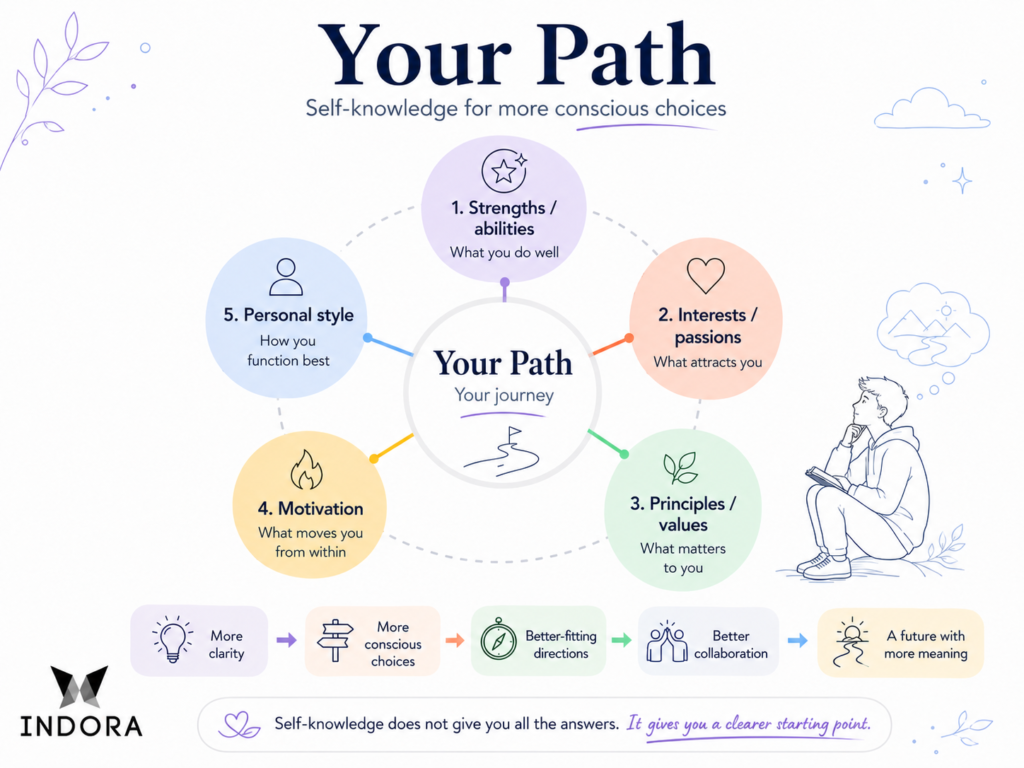
Teenagers are often expected to make important choices before they fully understand themselves. Self-knowledge helps them connect abilities, interests, values, motivation and personal style into a clearer personal direction.
Teenagers are often asked big questions very early.
What profile will you choose?
What subjects are you good at?
What university do you want?
What career are you thinking about?
What do you want to do with your life?
These questions matter. But they can also feel overwhelming when a young person is still discovering who they are, what they value, how they learn, what gives them energy and what kind of future feels meaningful to them.
This is why self-knowledge matters.
Before young people can make conscious educational or career decisions, they need time and support to understand themselves better.
Adolescence is not only a transition
Adolescence is often described as a stage between childhood and adulthood.
But it is much more than a transition.
It is a period of identity formation, emotional development, social comparison, pressure, curiosity, insecurity and possibility. Teenagers are trying to understand not only the world around them, but also their place in it.
They may ask themselves:
Who am I?
What am I good at?
What do others expect from me?
What do I actually want?
Where do I belong?
What kind of future is possible for me?
These questions are not superficial.
They are part of growing up.
When adults ignore them and focus only on performance, grades or career choices, young people may feel pushed toward decisions they do not fully understand.
Career orientation should start with the person
Career guidance is often reduced to choosing a job. But for teenagers, this can be too narrow.
Many young people do not yet know what job they want. And that is normal. At this stage, it may be more useful to help them explore who they are before asking them to define exactly what they will become.
A better starting point is:
What do I do well?
What attracts my attention?
What matters to me?
What motivates me?
How do I work best?
What kind of environment helps me grow?
These questions do not produce one perfect answer.
But they create a personal map.
And that map can support better choices.

Abilities: what comes naturally
One important part of self-knowledge is understanding personal strengths.
Teenagers often associate ability with school grades. If they are good at mathematics, languages, sports or art, they may recognize that as a strength. But many abilities are less visible.
Some young people are good at explaining things clearly.
Some organize people naturally.
Some notice when others feel excluded.
Some solve practical problems quickly.
Some think visually.
Some listen deeply.
Some lead quietly, without needing attention.
These abilities matter.
A teenager who understands their strengths can begin to see possible directions. Not as fixed labels, but as clues.
Analytical thinking may point toward problem-solving fields.
Communication may point toward education, law, media or advocacy.
Creativity may point toward design, arts, digital content or innovation.
Organization may point toward project management, entrepreneurship or coordination.
Empathy may point toward psychology, social work, health, education or community support.
The goal is not to put young people into boxes.
The goal is to help them notice patterns.
Interests: where attention naturally goes
Interests are another important clue.
Teenagers may not always know how to describe their passions formally. But they often know what captures their attention.
What makes them lose track of time?
What topics do they talk about without getting bored?
What do they search online?
What would they try if they were not afraid of failing?
What do they do “just to see if they can”?
Interest is not the same as a career plan.
But interest shows energy.
And energy matters in learning.
A young person who is curious about something is more likely to explore, practise, ask questions and persist. This does not mean every interest must become a profession. But interests can reveal direction, motivation and potential.
Values: what matters when choices become difficult
Values are often overlooked in career orientation.
But they are essential.
Values shape decisions. They influence what feels meaningful, what feels unacceptable, what kind of work environment feels right, and what kind of success feels worth pursuing.
A teenager may value freedom, stability, creativity, family, recognition, justice, money, balance, community, leadership, independence, safety or helping others.
None of these values are automatically better than the others.
But they lead to different choices.
A young person who values stability may imagine the future differently from someone who values adventure.
Someone who values creativity may struggle in rigid environments.
Someone who values justice may need work that feels socially meaningful.
Someone who values independence may be drawn to entrepreneurship or flexible work.
Someone who values community may need connection and collaboration.
When teenagers understand their values, they make choices with more awareness.
They can ask not only “Can I do this?” but also “Does this fit what matters to me?”
Motivation: what moves a young person from within
Abilities show what someone can do.
Motivation shows why they might want to do it.
This distinction is important.
Two teenagers may both be good at communication. One may enjoy public speaking because they like influence and leadership. Another may communicate well because they want to help people understand difficult things.
Two young people may both be organized. One may love structure and planning. Another may organize because they care about fairness and want the group to function better.
Motivation gives meaning to ability.
Without motivation, even a strong skill may remain unused. With motivation, a young person is more likely to practise, improve and stay connected to their goals.
This is why teenagers need opportunities to reflect on what moves them from within — not only on what others say they should do.
Personal style: how each teenager functions best
A good choice is not only about the field.
It is also about the environment.
Some teenagers work best in teams. Others need quiet and independence. Some need clear instructions. Others need creative freedom. Some enjoy competition. Others prefer cooperation. Some are energized by people. Others need time alone to think.
Understanding personal style helps young people make better decisions about learning, study, work and collaboration.
It also helps them avoid comparing themselves unfairly with others.
There is not one correct way to grow.
Some people grow through structure.
Some grow through experimentation.
Some grow through dialogue.
Some grow through reflection.
Some grow through challenge.
Some grow through encouragement.
When teenagers understand how they function, they can choose environments that support their development instead of constantly feeling that something is wrong with them.
Self-knowledge reduces pressure
Many teenagers feel pressure to have clear answers.
But not knowing yet is not failure.
Adolescence should include exploration. Young people need space to test ideas, change their minds, discover new interests and understand themselves gradually.
Self-knowledge does not remove uncertainty.
But it makes uncertainty less chaotic.
A teenager may still not know exactly what career they want, but they may begin to say:
I know I enjoy working with people.
I know I need variety.
I know I care about fairness.
I know I am good at explaining things.
I know I do not want a path that ignores creativity.
I know I need to build more confidence before speaking in public.
These are not final answers.
But they are meaningful steps.
Support from adults matters
Teenagers do not need adults to decide for them.
But they do need adults who can ask better questions.
Instead of asking only “What do you want to become?”, we can ask:
What did you enjoy learning recently?
When did you feel proud of yourself?
What kind of task makes you feel capable?
What do people ask you for help with?
What kind of problems do you care about?
What would you like to try if there were no pressure to be perfect?
These questions create reflection.
They help young people connect experience with self-understanding.
Adults can support this process by listening without rushing, offering feedback without labelling, and helping teenagers see strengths they may not yet recognize.
Self-knowledge is not a luxury
Sometimes, self-knowledge is treated as something optional.
But it is not.
It supports educational choices, career orientation, emotional development, confidence and agency.
A young person who understands themselves better is more able to:
make conscious decisions;
communicate their needs;
choose suitable learning environments;
recognize their strengths;
manage pressure;
set realistic goals;
adapt when plans change;
build a future that feels connected to who they are.
This is why self-knowledge should be part of education, not an afterthought.
What we believe at INDORA
At INDORA, we believe that learning should help people understand both the world and themselves.
For teenagers, this means creating spaces where they can explore their abilities, interests, values, motivation and personal style in a safe and structured way.
It means helping them build language for who they are becoming.
It means showing them that personal development is not about having perfect answers.
It is about asking honest questions and learning how to make choices with more clarity.
Conclusion
Teenagers do not need to know everything about their future.
But they do need support to understand themselves.
Because better choices begin before the decision itself.
They begin when a young person starts to notice:
what they do well,
what attracts them,
what matters to them,
what motivates them,
and how they grow best.
Self-knowledge does not give a ready-made path.
It helps young people build one.