For employers hiring foreign workers in Romania, organising Romanian language courses is only one part of the responsibility. The other part is being able to show, clearly and calmly, what was organised, who participated, how the course was followed and what documentation exists.
This is where many companies get stuck. They may have good intentions. They may even provide some form of language support. A Romanian colleague may help with basic words. A supervisor may explain instructions slowly. Someone from HR may translate key messages when needed.
All of this can be useful in daily work. But informal support is not the same as a structured and documented Romanian language and integration programme.
Under OUG no. 32/2026, employers need to think about Romanian language learning not only as an educational activity, but also as a process that should be planned, followed and documented. For HR teams, this means one simple thing: if the company provides Romanian language training for foreign workers, the company should also be able to explain and document that training.
A course that cannot be documented properly can quickly become a source of stress.
Documentation is not bureaucracy. It is protection.
Many employers hear the word “documentation” and immediately think of paperwork, folders and unnecessary administrative pressure. But in this case, documentation has a practical purpose.
It helps the employer understand what has actually happened.
Who was enrolled? When did the course start? What format was agreed? How was participation followed? Was there any progress information? What confirmation was issued at the end?
A well-documented course tells the story of the learning process from beginning to end. It gives HR a clear record. It gives management visibility. It gives the course provider a framework. And, most importantly, it prevents the company from trying to reconstruct everything later from emails, messages, spreadsheets and memory.
For foreign workers, documentation can also support a better learning experience. When the course is structured, workers know what they are expected to do. They understand the pathway. They can see progress. They are not simply told, vaguely, that they “must learn Romanian”.
A documented course is usually a better organised course.
The first thing employers should clarify: what exactly is the programme?
Before thinking about certificates or reports, employers should start with the basic question: what course are we actually offering?
A vague arrangement is not enough. The employer should be able to identify the course provider, the programme name, the period covered, the delivery format and the general structure of the learning pathway. If the course includes Romanian language learning and cultural and social integration, this should be visible in the course description or agreement.
This does not mean the contract has to become unreadable. It means it should contain enough detail to make the programme understandable.
A company should not be in the position of saying: “We had some Romanian lessons, but we are not sure exactly how they were organised.”
The course should have a shape. It should have a beginning, a structure and a completion logic.
Participation records matter more than people think
One of the most common weaknesses in training programmes is the gap between enrolment and actual participation.
It is easy to say that a worker was registered for a course. It is much harder to show whether that worker actually accessed the lessons, completed activities, attended sessions or followed the learning pathway over time.
This is why participation records matter.
For face-to-face courses, this may mean attendance sheets. For online courses, it may mean platform activity records, completed lessons, progress status or periodic participation summaries. The exact format depends on the course model, but the principle is the same: participation should not exist only as an assumption.
For HR teams, this can make the difference between calm and chaos. If participation is tracked throughout the programme, information is available when needed. If nobody tracks it, the company may discover too late that some workers were enrolled but inactive, that records are incomplete, or that the course was never followed consistently.
A Romanian language programme should not become another invisible HR process. It should be visible enough to manage.
Attendance is not the same as learning
Another important point is progress. A person can be present in a course without necessarily understanding or improving. This is true for any learning process, not only for language learning.
Romanian language courses for foreign workers should therefore include some form of learning activity, practice or evaluation. This does not need to become an academic exam. The goal is not to put unnecessary pressure on workers. The goal is to understand whether the course is producing engagement and whether learners are moving through the material.
Progress can be shown through short tests, completed exercises, practical communication tasks, module completion, initial and final activities or periodic summaries. What matters is that the course produces some evidence of learning, not only evidence of registration.
For employers, this is also useful operationally. If a group of workers is struggling, HR can see that support may be needed. If learners are progressing, the company can understand that the programme is working. If participation drops, the issue can be addressed before the end of the course.
Monitoring is not about control for the sake of control. It is about not flying blind.
Completion documents should be clear, not decorative
At the end of a course, workers may receive a certificate of participation or completion, depending on the agreed format and criteria. This document should be clear enough to be useful.
It should show who completed the course, what course was completed, when it took place and who issued the document. If the course has a specific duration, structure or completion criteria, these should be reflected in a reasonable way.
However, employers should also be careful about the language used around certificates. A certificate issued by a course provider is not automatically the same thing as an officially recognised language proficiency certificate. If a specific legal or administrative procedure requires an officially recognised certificate, the relevant institutional conditions should be checked separately.
For INDORA, the distinction is important. We can issue certificates of participation or completion for our own courses, according to the agreed course format. We do not present those certificates as official language proficiency certificates unless such recognition is provided through the competent framework.
Clarity protects everyone: the employer, the worker and the course provider.
Workers also need to understand the course
A documentation process should not focus only on the employer. Foreign workers also need clear information.
They should know why they are enrolled, how they access the course, what they are expected to complete, where they can ask for help and what kind of confirmation they may receive at the end.
This is especially important when workers are new to Romania, unfamiliar with local institutions or not confident in English or Romanian. If the course instructions are confusing, participation will suffer. If the worker does not understand the purpose of the course, the programme may feel like another administrative obligation imposed from above.
Good onboarding makes a difference. A short explanation, simple instructions and accessible communication can turn the course from “something HR told me to do” into “something that helps me function better at work and in daily life”.
The mistakes that create problems later
Most documentation problems do not appear because employers do not care. They appear because the process was never designed properly from the beginning.
One common mistake is relying only on informal Romanian support. A colleague explains words. A supervisor translates instructions. Someone helps when there is confusion. This may help the team in the moment, but it does not create a structured course record.
Another mistake is incomplete tracking. The company may have information for the first month, then nothing. Or it may have a list of participants, but no activity or progress information. These gaps make the course harder to demonstrate and harder to manage.
A third mistake is confusing different obligations. Health and safety training, workplace induction and Romanian language learning are connected in practice, but they are not the same thing. They should not be treated as interchangeable.
Finally, many companies wait until documentation becomes urgent. By then, it is much harder to rebuild the full picture. Documentation works best when it is built into the course from the start.
Why online delivery can make documentation easier
Online learning does not automatically solve every problem. A poorly designed online course can be just as confusing as a poorly organised face-to-face course.
But a well-structured digital learning format can make documentation much easier.
An online course can centralise enrolment, learning materials, activity completion, progress information and completion status. It can reduce the need for scattered spreadsheets or manual follow-up. It can also make participation easier for workers who are in shifts, in different locations or unable to attend fixed classroom sessions.
For employers, this is especially relevant when workers are spread across construction sites, factories, warehouses, restaurants, farms, cleaning teams or care settings. A single online learning structure can support several groups without requiring every participant to be physically present in the same place at the same time.
The value of digital learning is not that it looks modern. The value is that it can make learning easier to access and easier to follow.
What a clean HR file should be able to show
This is one of the few places where a short list is actually useful.
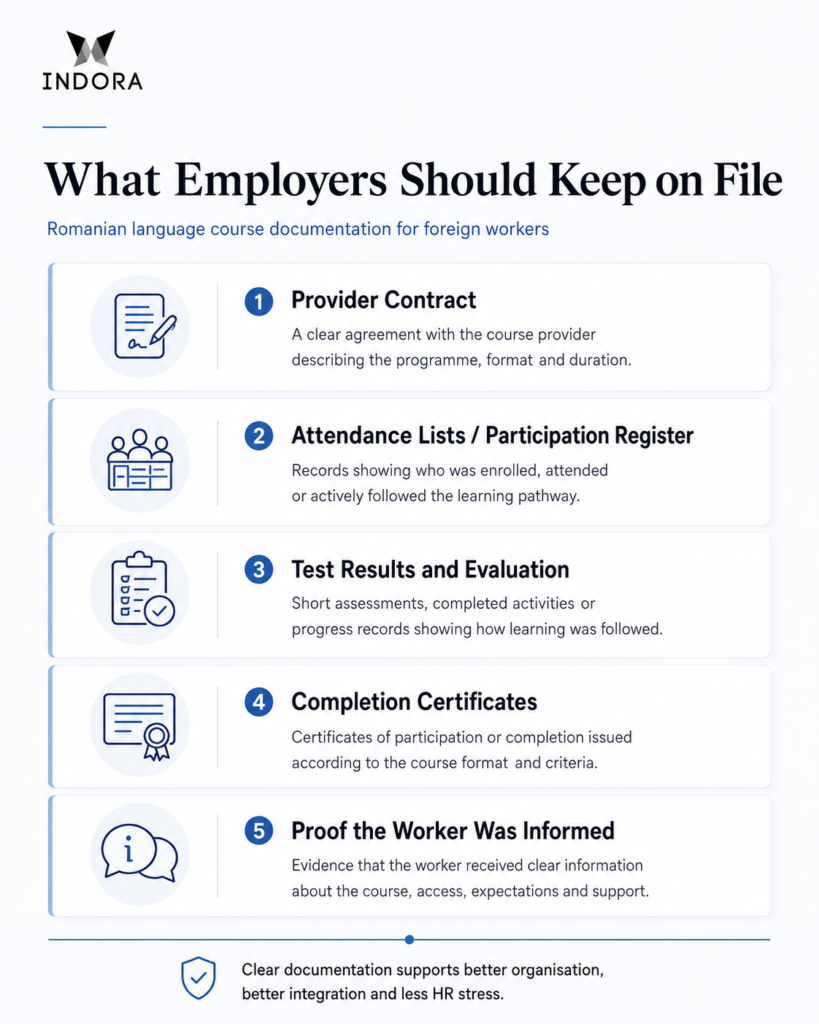
A clear documentation file for Romanian language and integration training should help HR show:
-what course was organised;
-who was enrolled;
-how the course was structured;
-how participation and progress were followed;
-what confirmation or certificate was issued at the end.
That is the core. Everything else depends on the course format, the employer’s situation and the agreed documentation model.
The point is not to create a mountain of paperwork. The point is to avoid uncertainty.
If someone asks what the company did to support Romanian language learning and integration, HR should be able to answer without panic.
How INDORA can support employers
INDORA provides online Romanian language learning designed for foreign workers and foreign citizens living in Romania, with a practical focus on communication, integration and everyday participation.
For employers, this means we can discuss a course format that combines Romanian language learning, cultural and social integration, practical workplace communication and clear course documentation.
Our approach is shaped by direct work with migrant, refugee and displaced communities. We understand that foreign learners need accessible language support, not abstract grammar disconnected from real life. We also understand that employers need structure, visibility and documentation, not another process that becomes impossible to manage.
Depending on the agreed setup, INDORA can support employers with structured online modules, practical learning activities, participation and progress information, periodic reporting and certificates of participation or completion according to the course criteria.
Where relevant, the format can be discussed in relation to the 6-month / 6 hours per week structure introduced by OUG no. 32/2026.
A good course should reduce stress, not create more of it
Romanian language learning for foreign workers should not become a box-ticking exercise. If it is treated only as a formal obligation, it will probably become frustrating for everyone.
Workers need language that helps them understand, ask, respond, work safely and participate in daily life. Employers need a course structure that can be followed, monitored and documented without turning HR into a paperwork machine.
The best solution is the one that brings these two needs together.
A good Romanian language course helps people learn. A good documentation process helps employers stay organised. When both are in place, the course becomes more than a compliance response. It becomes part of responsible integration.
Need to organise and document Romanian language courses for your foreign employees?
Tell us how many workers you need to enrol, what languages they speak, your industry and your preferred timeline.
INDORA will provide you with the appropriate package of Romanian language courses foreign workers OUG 32/2026