
Estimated reading time: 6 minutes
For many foreign workers, the first weeks in Romania are not only about starting a new job. They are about entering a completely new environment where almost everything sounds unfamiliar: workplace instructions, street signs, conversations between colleagues, announcements, forms, questions, warnings and everyday messages.
A worker may arrive motivated, experienced and ready to work. But without Romanian language support, even simple situations can become stressful. Where is the changing room? What time does the shift end? What does the supervisor want me to do? Is this instruction urgent? Am I allowed to use this equipment? Who should I ask for help?
This is why Romanian language learning should not be seen only as a formal course. For foreign workers, it can change the way they experience work, safety, relationships and daily life in Romania.
The change does not happen overnight. It usually happens gradually, through small moments of understanding that build confidence over time.
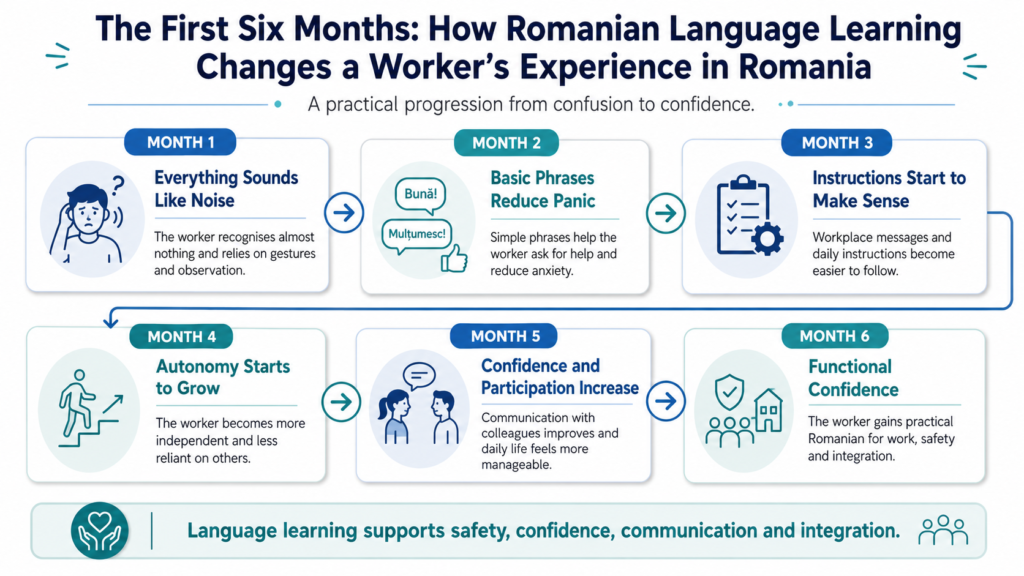
Month one: everything sounds like noise
The first month is often the hardest.
A foreign worker may be surrounded by people speaking Romanian all day, but the language may still feel like background noise. The worker watches gestures, copies colleagues and tries to understand the rhythm of the workplace without fully understanding the words.
This is tiring. It can also be risky.
In a warehouse, factory, construction site, hotel, kitchen or cleaning team, workers need to understand more than friendly conversation. They need to recognise warnings, basic instructions, equipment names, locations, schedules and emergency phrases.
In the first month, even a few Romanian words can make a difference. Words such as atenție, pericol, ajutor, pauză, ieșire, nu atingeți or am terminat are not abstract vocabulary. They are practical tools.
At this stage, the objective is not fluency. The objective is orientation. The worker begins to recognise repeated words, connect them to actions and understand that Romanian is not an impossible wall, but a system that can be learned step by step.
Month two: basic phrases reduce panic
By the second month, small phrases begin to matter.
A worker who can say “Nu înțeleg” or “Puteți repeta?” is no longer completely dependent on guessing. A worker who can ask “Unde este?” or “Cine este responsabilul?” has a way to ask for direction. A worker who can say “Am nevoie de ajutor” has a safer way to respond when something goes wrong.
These phrases may look simple, but their effect is significant.
They reduce anxiety. They reduce silence. They reduce the pressure to pretend to understand. They also show colleagues and supervisors that the worker is trying to communicate, not avoiding communication.
This is often the first visible change: the worker begins to participate, even imperfectly.
And imperfect Romanian is still valuable Romanian. In the workplace, communication does not have to be elegant to be useful. It has to be clear enough to prevent confusion.
Month three: instructions begin to make sense
Around the third month, many learners start connecting individual words into meaning.
They may not understand every word in a briefing, but they begin to understand the structure of the message. They recognise when the supervisor is explaining a task, warning about a problem, changing a schedule or giving instructions for the day.
This is a major shift.
Before this point, a worker may have relied mostly on observation. They watched what others did and copied the action. But copying is not the same as understanding. If the procedure changes, if a colleague makes a mistake or if the task is new, copying becomes fragile.
When Romanian starts to make sense, the worker gains a different kind of confidence. They can follow the logic of the task. They can ask for clarification. They can report a problem before it becomes bigger.
For employers, this is where language learning begins to connect directly with operational reality. A worker who understands more can work more safely, more independently and with less constant mediation.
Months four and five: autonomy starts to grow
By the fourth and fifth month, progress often becomes visible in relationships.
The worker may begin to speak more with Romanian colleagues. They may ask short questions during breaks. They may understand jokes, greetings or everyday comments. They may become less isolated from the local team.
At work, they may also become more independent. They know where to go, who to ask, what to say and how to describe a simple problem. They may still make mistakes, but they are no longer completely outside the communication flow.
This stage is important because integration is not only administrative. It is also emotional and social.
A worker who understands nothing around them can feel invisible, dependent and vulnerable. A worker who understands more begins to feel present. They can contribute. They can explain. They can respond. They can be recognised by others as part of the team.
For employers, this can improve the atmosphere in mixed teams. Communication becomes less dependent on one informal translator. Supervisors spend less time repeating basic instructions. Colleagues become more open when they see the effort to communicate.
Romanian language learning does not solve every workplace challenge, but it can remove one of the most persistent barriers.
Month six: confidence, participation and documentation
After six months of regular learning, the goal is not necessarily advanced Romanian. Most foreign workers will not become fluent in such a short time, especially if they are also working full time and adapting to a new country.
But fluency is not the only measure of success.
A realistic six-month objective is functional confidence. This means the worker can understand and use Romanian in practical situations: basic workplace communication, daily routines, safety-related vocabulary, simple questions, requests for help, reporting problems and interaction with colleagues or services.
For the employer, six months of structured learning should also create a clearer record of participation and progress. The company should be able to understand who was enrolled, what learning pathway was followed, how the worker participated and what completion document was issued.
This matters especially in the context of OUG no. 32/2026, where Romanian language learning and cultural and social integration are part of the employer’s responsibilities when hiring foreign workers in Romania.
A good course should therefore support both sides: the worker’s real learning experience and the employer’s need for structure and documentation.
Why consistency matters more than talent
Many workers are afraid they are “bad at languages”. In reality, the biggest factor is often not talent, but consistency.
A foreign worker does not need to learn everything at once. They need repeated exposure to useful words and phrases, connected to the situations they actually face. Ten or fifteen minutes of regular practice can be more effective than occasional long sessions that are quickly forgotten.
Workplace Romanian should be built around real use: understanding instructions, asking questions, identifying objects, reporting problems, describing basic needs and navigating daily life in Romania.
This is why practical Romanian language learning should not start with abstract grammar alone. Grammar has its place, but the first need is communication.
Workers need Romanian they can use.
What changes for the worker
The first six months can change the worker’s experience in several ways.
The workplace becomes less confusing. The worker can understand more of what is happening and feels less dependent on guessing.
Safety improves because warnings, instructions and emergency phrases become easier to recognise.
Daily life becomes more manageable. Going to the shop, using transport, asking for directions or speaking to a doctor becomes less intimidating.
Relationships improve because the worker can communicate directly with colleagues, even in simple Romanian.
Confidence grows because the worker is no longer only surviving the environment, but beginning to participate in it.
This is the real value of language learning. It gives people more control over their own life.
New in Romania? Start with the basics.
Download a short guide with practical Romanian phrases and first-month tips for foreign workers.
What changes for the employer
For employers, Romanian language learning is not only an integration measure. It can also improve communication, reduce misunderstandings and support workplace stability.
A worker who understands basic Romanian is easier to onboard. A mixed team communicates with less friction. Supervisors do not have to rely only on gestures, translation apps or informal mediators. HR has a clearer way to follow participation and progress.
This does not mean that language learning replaces proper onboarding, translated information, health and safety training or respectful management. It means that Romanian language support strengthens all of them.
When workers understand more, the whole workplace functions better.
Romanian learning as part of responsible integration
Responsible integration is not about expecting foreign workers to adapt alone. It is about creating a pathway that helps them adapt realistically.
That pathway should include clear information, practical support, cultural and social orientation, accessible language learning and documentation that helps the employer stay organised.
Romanian language learning is one part of that pathway, but it is a central one. Without language, many other forms of support remain incomplete.
The first six months matter because they shape the worker’s relationship with the workplace, the team and Romania itself.
A worker who spends six months confused, isolated and dependent may lose motivation. A worker who spends six months gradually understanding more may become more confident, more stable and more connected.
How INDORA can support employers
INDORA provides online Romanian language learning designed around practical communication, integration and the real-life needs of foreign citizens in Romania.
For employers, INDORA can discuss a course format that supports Romanian language learning, cultural and social integration, workplace communication, participation monitoring and course documentation.
Our approach is practical and human. We focus on language that helps people function in real situations, not only on grammar exercises disconnected from daily life.
Where relevant, the course format can be discussed in relation to the 6-month / 6 hours per week structure introduced by OUG no. 32/2026.
Participants may receive INDORA certificates of participation or completion according to the agreed course criteria. If an officially recognised language proficiency certificate is required for a specific legal or administrative procedure, the applicable institutional requirements should be checked separately.
Conclusion: language changes the experience of being here
Learning Romanian does not change everything in one day. But over six months, it can change the way a foreign worker experiences Romania.
The workplace becomes more understandable. Daily life becomes less intimidating. Communication becomes more direct. The worker becomes more confident, and the employer gains a clearer, more structured integration process.
For foreign workers, Romanian is not only a language. It is access, safety, autonomy and belonging.
For employers, it is not only a course. It is an investment in better communication, stronger teams and more responsible integration.
Need Romanian language support for your foreign employees?
Tell us how many workers you need to enrol, what languages they speak, your industry and your preferred timeline.
INDORA provides Romanian Language Course for Foreigners — online Romanian language courses aligned with OUG 32/2026, designed for employers, organisations and foreign workers in Romania.
NEED A ROMANIAN LANGUAGE COURSE FOR YOUR EMPLOYEES?
Whether you employ foreign workers directly or support companies that do, we can help you organise an online Romanian language and integration course aligned with OUG no. 32/2026.