
In short: To work legally in Romania as a non-EU citizen, you need an employer in Romania, a long-stay visa for employment, and a procedure completed through the WorkinRomania.gov.ro platform. There are two main routes: D/AM1 (direct employment for highly qualified and special categories, no quota) and D/AM2 (through an authorised placement agency, for permanent, seasonal and cross-border workers in shortage occupations, subject to the annual quota of 90,000 workers for 2026). Romanian law protects you: equal pay, contract in your language, salary into your bank account, no fees from agencies, and a mandatory Romanian language course of at least 6 months. This guide explains the full process, your rights, and what to watch out for.
If you are a foreign worker considering, preparing for, or already in employment in Romania, this guide is for you. It is based on official information published by the General Inspectorate for Immigration (Inspectoratul General pentru Imigrări, IGI) and on the provisions of Government Emergency Ordinance 32/2026 (OUG 32/2026). Everything here applies equally to you, regardless of your nationality. The law does not protect some workers more than others; it protects all workers the same way.
Contents
- What legal employment in Romania means
- The two employment routes: D/AM1 and D/AM2
- The main steps of the process
- Documents you will usually need
- What the contract and the job offer must include
- Your rights and protections
- The Romanian language course: your right, not a favour
- Your obligations
- Changing employer and what happens if the contract ends
- Costs, fees and warning signs
- Special situations
- If your rights are violated: where to report
- Frequently asked questions
What legal employment in Romania means
Legal employment in Romania means three things are in place: you have an employer in Romania, you hold a long-stay visa for employment (in most situations), and the procedure has been completed through the official platform, WorkinRomania.gov.ro. The platform is where the employer or the authorised placement agency uploads the single application and the required documents, and where the authorities verify whether the conditions are met.
The long-stay visa for employment also certifies your right to work on Romanian territory. After entering Romania, your right of stay is generally extended by obtaining the single permit (permis unic) or, for highly qualified workers, the EU Blue Card.
Working without a visa, without a registered contract, or on the basis of verbal promises alone is not legal employment. If someone offers you work in Romania without a visa or without the legal procedure, that is a warning sign, not a shortcut.
The two employment routes: D/AM1 and D/AM2
D/AM1: direct employment
This route is for highly qualified workers and several special categories: persons carrying out activities requested by ministries or central public authorities, teaching and scientific staff in state higher education, artists in public cultural institutions, professional athletes, and citizens of the Republic of Moldova, Ukraine and the Republic of Serbia employed full-time.
For D/AM1, the single application is submitted directly by the employer in the platform. No authorised placement agency is needed. The visa is not conditioned on the shortage occupations list and is not subject to the annual quota.
D/AM2: through an authorised agency or authorised employer
This route is for permanent, seasonal and cross-border workers, in occupations included on the List of shortage occupations (Lista ocupațiilor deficitare). The single application is submitted either by an authorised placement agency (for a registered employer, on behalf of the worker) or directly by an authorised employer, where applicable.
For D/AM2, several contracts are required: the placement contract between the agency, the employer and the worker; the service contract between the agency and the employer; and the individual employment contract (contract individual de muncă, CIM) registered in REGES-ONLINE. The D/AM2 visa is issued only if the annual quota of 90,000 workers (for 2026) has not been exhausted.
The main steps of the process
Regardless of the route, the process follows a clear sequence. Each step builds on the previous one:
- A real job is identified. You must be connected with an employer in Romania. For D/AM2, the occupation must be on the List of shortage occupations and the employer must be registered in the Register of Employers of Foreign Workers (Registrul Angajatorilor de Străini, R.A.S.).
- The firm job offer is uploaded. The employer uploads a detailed offer in the platform: job title, qualification, duration, working time, gross and net salary, payment method, leave, working conditions, accommodation, transport and repatriation where provided.
- The contracts are concluded. The individual employment contract is signed between you and the employer. For D/AM2, a placement contract and a service contract are also concluded.
- The contract must be in your language. The employment contract and, where applicable, the placement contract must be available in Romanian and in the language of your country of origin or in an international language you understand. Never sign a contract you cannot read.
- The single application is uploaded. The employer or the authorised agency uploads the application and documents in WorkinRomania.gov.ro. The authorities verify the conditions.
- You appear at the diplomatic mission. You present yourself in person for the visa, with your travel document and the documents proving the purpose and conditions of stay. Biometric data are collected.
- The visa is issued and you enter Romania. If approved, the long-stay visa for employment is issued. It allows entry into Romania and certifies your right to work.
- You start work and extend your stay. After entering Romania, you start work according to the contract. For a longer stay, you request an extension and the issuance of the single permit or EU Blue Card.
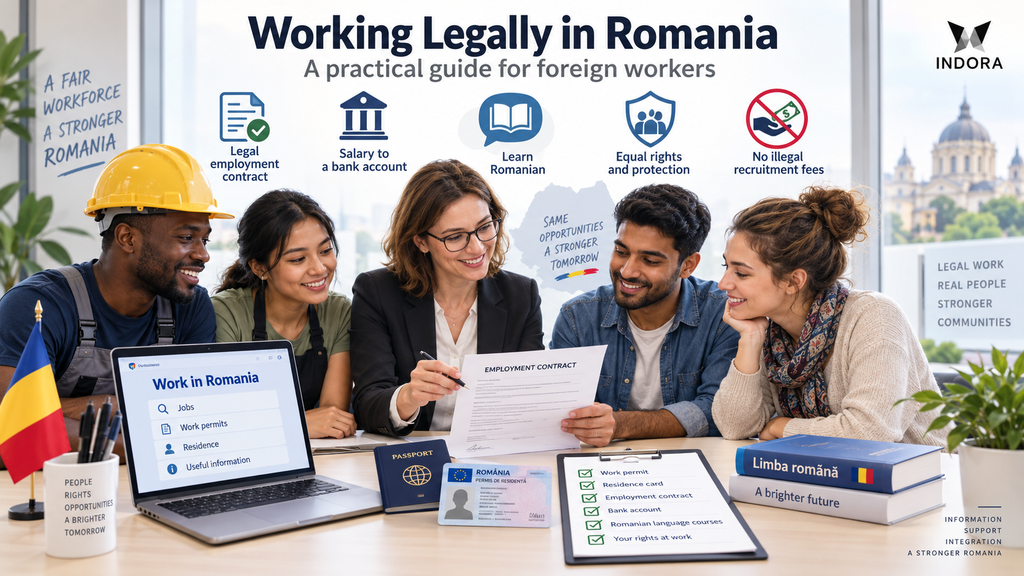
Documents you will usually need
The exact list depends on your category and route. As a general checklist, prepare:
- a valid passport or travel document;
- the individual employment contract registered in REGES-ONLINE, or the contractual documents required for your category;
- travel medical insurance covering the entire visa period, including repatriation for medical reasons, emergency treatment, hospitalisation and death, valid throughout EU Member States, with minimum coverage of EUR 30,000;
- a criminal record certificate or equivalent from your country of origin or residence, translated and legalised;
- proof of means of subsistence at the level of the gross minimum salary for 90 days, where required;
- CV and documents on education, qualifications, professional experience or authorisation, where the job requires them;
- for regulated professions or highly qualified jobs: documents recognising studies, qualifications or authorisation;
- for a minor worker: notarised consent of the parents or legal representative, apostilled or superlegalised and translated.
What the contract and the job offer must include
For your protection, the essential information must be clear before you leave your country and before you sign. The contract and the firm job offer must cover:
- The job: job title, occupation and COR code, qualification level, place of work, duration of employment, hiring and termination conditions.
- Working time: maximum working time (8 hours/day, 40 hours/week), daily and weekly rest, compensation for overtime.
- Salary: gross and net monthly salary, hourly rate, payment method, payment date, the applicable minimum salary, bonuses and other salary rights.
- Leave and social protection: minimum paid annual leave (at least 20 working days), how it is granted, contributions, taxes, and rights in case of work accidents, occupational diseases or death.
- Working conditions: occupational health and safety (SSM), workplace hygiene, protective equipment, and training in a language you understand.
- Accommodation and transport: whether provided by the employer or paid by you, under what conditions, including transport from your country of origin, internal transport and repatriation.
If any of these elements are vague, missing, or different from what you were told verbally, ask for clarification before signing. Under Order 655/2026 (Ordinul 655/2026, published in the Official Gazette no. 484 of 11 June 2026), contracts that do not contain the mandatory elements may be declared null.
Your rights and protections
Romanian law gives you a clear set of rights. These are not optional for your employer. They apply by law, and they apply to you in the same way as to a Romanian worker:
- Equal treatment. You must receive working conditions, pay, and occupational safety at the same level as Romanian workers doing the same job.
- Salary into your own bank account. Your salary must be paid into your personal bank account, not in cash.
- Contract in a language you understand. The employment contract (and the placement contract, if applicable) must be available in Romanian and in your language or an international language you understand. An employer who concludes the contract only in Romanian can be fined 6,000 lei for each such contract.
- No fees from agencies. An authorised placement agency (agenție de plasare) in Romania may not charge you commissions, fees, charges, guarantees or deposits for placing you on the Romanian labour market.
- Information before arrival. For workers placed through an agency, essential information must be communicated at least 10 days before your arrival in Romania, in a language you understand.
- Safety training in your language. The employer must provide occupational health and safety training in a language you understand and must provide the necessary protective equipment.
- Access to complaint procedures. You must have access to complaint and abuse-reporting procedures, including through the platform, under conditions of confidentiality.
- Accommodation cap. If the employer provides accommodation, the rent may not exceed 25% of your net salary.
- Contact details for reporting. The placement contract must include the contact details of the institutions where you can report violations: the Labour Inspectorate (Inspecția Muncii / ITM), the General Inspectorate for Immigration (IGI), the Romanian Police (112), the National Agency against Trafficking in Persons (ANITP) and the National Agency for Employment (ANOFM).
The Romanian language course: your right, not a favour
The employer must provide Romanian language courses that include cultural and social orientation for at least 6 months from the start of work, for a minimum of 6 hours per week. In volume, that is roughly 156 hours of course per worker.
This is not optional. Under Order 655/2026, the course is a mandatory clause in your employment contract, with a dedicated field for the course provider and the schedule. If your employer has not organised any course, or if you have never been told about it, that is a gap in their obligations, not something you should feel guilty about asking for.
The course is meant to help you communicate at work, understand your rights, navigate daily life and feel more at home in Romania. It is a right the law gives you, not a favour your employer grants you.
Your obligations
Rights come with responsibilities. As a foreign worker in Romania, you are expected to:
- provide true, complete and up-to-date information about your identity, qualifications, experience and, within legal limits, health status;
- respect the employment contract, internal rules, occupational health and safety rules, work discipline and the employer’s lawful instructions, under the Labour Code (Codul Muncii, Law 53/2003);
- report to the workplace and perform the activity according to the contract;
- respect the placement contract, where applicable, to the extent it does not conflict with labour law or immigration rules;
- comply with the rules on lawful stay in Romania and with the deadlines for your residence permit or extension of the right of stay.
The most important practical point: keep your documents in order and respect the deadlines for your residence permit. Losing your legal status because of a missed deadline is one of the most common and most avoidable problems.
Changing employer and what happens if the contract ends
This is one of the areas where many workers receive wrong advice. Here is what the law says:
- The general rule: you may change employer by resignation after at least 6 months from the start of work with your current employer, as registered in REGES-ONLINE.
- The exception: the 6-month period may be reduced in justified cases of serious breach by the employer of contractual clauses or employment relations.
- If your contract ends early: your right of stay remains valid until the expiry of the period granted, but no longer than the period during which you receive unemployment benefit or, without it, no longer than 90 days from the termination of employment.
- If you were placed through an agency: the agency must make efforts to present you at least two job offers within the 90-day period. If no new employer is found, the agency bears the costs of removal measures.
Do not resign from a legal job before the new procedure is clear and the new employer is fully able to complete the application. If you leave your legal status unprotected and the new employer cannot complete the procedure, you may fall out of legal status through no real fault of your own. Facts protect you better than arguments; get everything in writing before you move.
Costs, fees and warning signs
Pay close attention to money and promises. The rules are clear:
- an authorised placement agency in Romania may not ask you for a commission, fee, charge, guarantee or deposit for placement;
- the costs for the visa, transport from your country and accommodation are borne by you unless the firm job offer states they are borne by the employer;
- any amount you must pay should be clear, justified and mentioned in the contract or the offer;
- you should never accept informal payments or promises without a written contract.
Warning signs that should make you stop
- you are asked to pay a commission to get a job in Romania;
- you do not receive the contract before departure, or you do not receive it in a language you understand;
- the salary, working time, accommodation or transport are presented vaguely or change from one conversation to another;
- you are promised entry into Romania without a visa or without the legal procedure;
- your passport is retained or you are asked to sign documents you do not understand;
- you are promised a job different from the one in the contract or a different occupation from the one declared.
If any of these apply to you, do not proceed without checking. These are exactly the patterns used by abusive intermediaries and traffickers. Stay calm, keep your evidence, and seek help.
Special situations
The law addresses several specific categories with adapted rules:
- Highly qualified workers (D/AM1): upon extension, the right of stay may be granted for the duration of the contract plus 3 months, for a maximum of 3 years.
- Seasonal workers: visa and extension linked to the contract duration plus 5 days; the employer must provide accommodation free of charge or for payment, under adequate conditions.
- Cross-border workers: may be employed in a border locality in Romania if they are citizens of a neighbouring country and live in the border area of that country.
- Foreign students legally staying in Romania: may work under a part-time contract, up to 6 hours per day, on the basis of their residence permit for studies.
- Workers already holding a right of stay for employment: may work for a second employer under a part-time contract of up to 4 hours per day, if they have an active full-time contract.
- Long-term residents, family members of Romanian citizens, protection beneficiaries, asylum seekers with labour-market access, tolerated persons: may be employed on the basis of the residence permit they already hold.
If your rights are violated: where to report
If you believe your rights are being violated, you are not alone and you are not without help. You can report to:
- The Labour Inspectorate (Inspecția Muncii / ITM) — for violations of labour law, salary, working time, safety.
- The General Inspectorate for Immigration (Inspectoratul General pentru Imigrări, IGI) — for issues related to residence, visas, work permits.
- The Romanian Police (112) — for emergencies, threats, violence.
- The National Agency against Trafficking in Persons (Agenția Națională Împotriva Traficului de Persoane, ANITP) — if you suspect trafficking or exploitation.
- The National Agency for Employment (Agenția Națională pentru Ocuparea Forței de Muncă, ANOFM) — for employment-related support.
You can also report through the WorkinRomania.gov.ro platform, under conditions of confidentiality. Keep records of everything: messages, contracts, payments, dates, names. Your records are your protection.
More help for your life in Romania
INDORA supports foreign workers settling into life and work in Romania. You may also find these guides helpful: understanding your employment contract, your rights at work: hours, breaks and leave, what to do if you are not paid on time, and our complete guide to OUG 32/2026 for foreign workers.
Frequently asked questions
Can I work in Romania without a visa?
In most cases, no. Legal employment requires a long-stay visa for employment (D/AM1 or D/AM2), obtained through the procedure in WorkinRomania.gov.ro. Working without a visa is not legal and puts you at serious risk. If someone promises you work without a visa, treat it as a warning sign, not an opportunity.
Can the agency charge me money to get a job in Romania?
No. An authorised placement agency in Romania is legally prohibited from charging you commissions, fees, charges, guarantees or deposits. If an agency asks you for money for placement, that is a violation of the law.
Does my contract have to be in my language?
Yes. The employment contract and, where applicable, the placement contract must be available in Romanian and in the language of your country of origin or in an international language you understand. An employer who issues the contract only in Romanian faces a fine of 6,000 lei per contract.
Can I change employer?
Yes, but after at least 6 months from the start of work with your current employer, as registered in REGES-ONLINE. The period may be shorter in cases of serious breach by the employer. Do not resign before the new employer can complete the procedure and your status is secure.
What happens if my contract ends before my permit expires?
Your right of stay remains valid until the expiry of the period granted, but no longer than the period of unemployment benefit or, without it, no longer than 90 days from the termination of employment. Use this time to find a new employer through the legal procedure.
What should I do if my passport is taken?
This is illegal. No one may retain your passport or identity documents, under any pretext. If this happens, contact the Police (112), IGI or ANITP immediately. Keep a copy of your passport separately, in a safe place.
Do I have the right to a Romanian language course?
Yes. The employer must provide Romanian language courses with cultural orientation for at least 6 months, for a minimum of 6 hours per week. Under Order 655/2026, this is a mandatory clause in your employment contract. It is a legal obligation, not a favour.
What if I am being exploited or my rights are violated?
Report to the Labour Inspectorate (Inspecția Muncii / ITM), IGI, the Police (112), ANITP or ANOFM. You can also report through WorkinRomania.gov.ro, under conditions of confidentiality. Keep all evidence: contracts, messages, payment records, dates and names.
This guide is based on official information from the General Inspectorate for Immigration (IGI) and on the provisions of Government Emergency Ordinance 32/2026 (OUG 32/2026, published in the Official Gazette no. 335 of 27 April 2026) and Order 655/2026 (published in the Official Gazette no. 484 of 11 June 2026). It is for general information and does not constitute legal advice. Procedures, documents and conditions may change. For your specific situation, check directly with IGI and, where possible, seek qualified legal assistance.