
Estimated reading time: 8 minutes
Hiring foreign workers in Romania is entering a new stage. Under Government Emergency Ordinance no. 32/2026 (OUG 32/2026), employers hiring foreign citizens in Romania face clearer responsibilities regarding language learning, cultural and social integration, workplace communication and documentation.
One of the most important changes for employers is the requirement to ensure Romanian language courses that also include elements of cultural and social integration for foreign workers. According to the ordinance, these courses must be organised for a period of at least 6 months from the date the worker starts activity in Romania, as recorded in REGES-ONLINE, with a minimum duration of 6 hours per week.
For HR teams and company managers, this is not simply a new administrative task. It changes the way foreign worker integration must be planned, documented and connected to daily workplace reality.
A worker who understands instructions, safety procedures and basic workplace communication is better prepared to participate in the team. An employer who can document the integration process is better prepared for internal monitoring and external verification.
At INDORA, we see Romanian language learning as both an integration measure and a practical workplace tool: one that supports communication, safety, stability and responsible employment.
What does OUG no. 32/2026 require from employers?
OUG no. 32/2026 regulates access of foreign citizens to the Romanian labour market, including the registration and authorisation of employers, the activity of foreign worker placement agencies and the digital management of employment procedures through WorkinRomania.gov.ro.
For employers hiring foreign workers in Romania, Article 7 introduces several relevant obligations.
Among these, employers must:
-conclude individual employment contracts both in Romanian and in the foreign worker’s language of origin or in an international language that the worker understands;
-provide occupational health and safety instruction in a language understood by the foreign worker;
-make available the documents and information needed for verification by the competent authorities;
-ensure Romanian language courses that include elements of cultural and social integration;
-keep supporting documents concerning the fulfilment of the obligations provided by Article 7 for at least 5 years after the end of the employment relationship.
The Romanian language and integration course requirement is particularly important because it is not formulated as an optional benefit. It is part of the employer’s legal responsibilities when employing foreign workers on the territory of Romania.
Romanian language and integration courses: the essential requirement
Under Article 7 paragraph (1) letter g) of OUG no. 32/2026, employers must ensure, either directly or through accredited providers, or in collaboration with public institutions, non-governmental organisations, international organisations or educational institutions, Romanian language courses that include cultural and social integration elements for foreign workers.
The required structure is clear:
–minimum duration: 6 months;
–starting point: from the date the foreign worker begins activity in Romania, as registered in REGES-ONLINE;
–minimum weekly workload: 6 hours per week;
–content: Romanian language learning plus cultural and social integration elements.
This means that companies should not wait until a worker has already faced communication difficulties or workplace misunderstandings. Integration planning must begin alongside employment planning.
For employers, the practical question becomes:
Do we have a structured course pathway, participation records and clear documentation if we need to demonstrate how we fulfilled this obligation?
What is the risk of non-compliance?
The ordinance also introduces financial consequences.
Failure to comply with certain obligations under Article 7, including the obligation to ensure Romanian language and integration courses, may be sanctioned with a fine of RON 5,000 to RON 10,000 for each foreign worker, according to Article 42 of OUG no. 32/2026.
For a company employing multiple foreign workers, this is not a minor administrative exposure. It can become a significant compliance and financial risk.
But the issue is not only the fine. Companies also need to consider:
-missing or incomplete documentation;
-HR time lost trying to reconstruct participation records;
-communication difficulties on site or in operational teams;
-misunderstandings regarding safety instructions;
-weaker retention of foreign employees;
-reduced confidence in the company’s onboarding and integration processes.
A last-minute solution is rarely a good solution. A structured integration programme should be prepared before documentation becomes urgent.
Why Romanian language courses under OUG 32/2026 matter for business
Romanian language learning is often treated as an educational service. For employers of foreign workers, however, it is directly connected to everyday operations.
A foreign employee may need Romanian in order to:
-understand simple instructions from a supervisor;
-identify warnings and safety information;
-report a problem;
-communicate with Romanian colleagues;
-understand basic administrative or workplace information;
-interact with services and institutions outside working hours;
-gain independence and confidence in daily life.
For the employer, these skills may contribute to:
-clearer workplace communication;
-fewer repeated explanations and misunderstandings;
-more effective onboarding;
-better cooperation in mixed teams;
-increased employee stability and retention;
-a more responsible and inclusive employment environment.
A Romanian language course for foreign workers should therefore not be a generic grammar class disconnected from reality. It should be built around the situations workers and employers actually face.
What should an effective programme include?
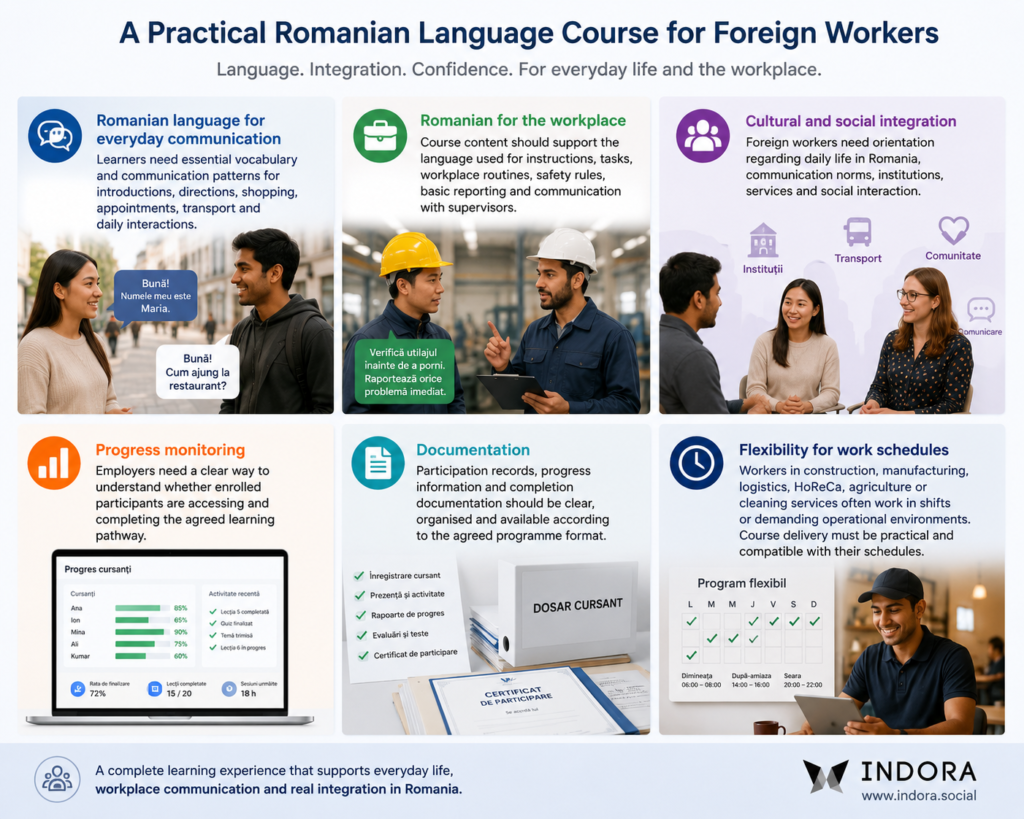
A programme designed for foreign workers in Romania should connect legal requirements with practical learning needs.
At a minimum, companies should look for a programme that includes:
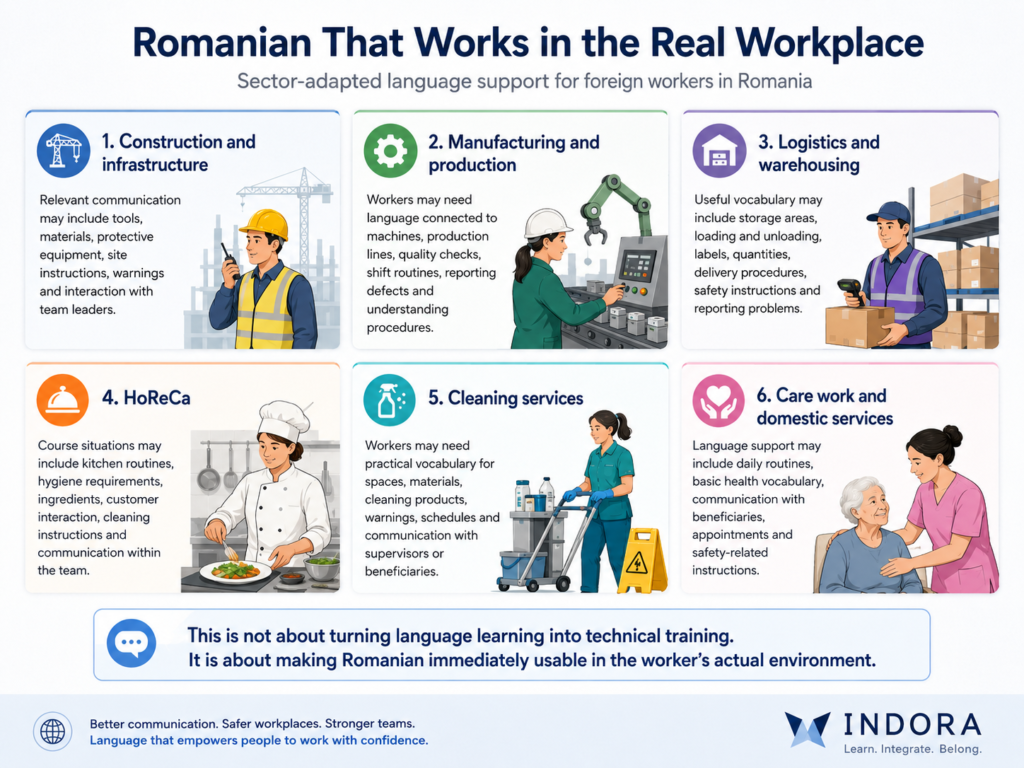
Different industries need different Romanian language scenarios
A foreign worker employed in a restaurant does not need exactly the same vocabulary as a worker on a construction site or in a warehouse.
This is why practical Romanian language learning should be adapted, where relevant, to the employment context.
Why online delivery matters for employers
For many companies, the greatest barrier is not understanding that language learning is useful. It is finding a format that does not disrupt operations.
An online course model can help companies organise learning in a more flexible way, especially when employees work across different locations or shifts.
Online delivery can support:

For HR departments, an online format may also reduce the administrative burden of managing groups, monitoring participation and collecting progress information.
How INDORA can support employers and organisations
INDORA provides an online Romanian language course model for foreign workers and other foreign citizens living in Romania, with a practical focus on communication, integration and everyday participation.
Our approach is based on direct experience working with migrant, refugee and displaced communities, as well as on the understanding that language learning must be accessible, relevant and connected to real needs.
For employers and partner organisations, INDORA can discuss a course format that includes:
- Romanian language learning for foreign workers;
- cultural and social integration content;
- practical workplace and everyday communication;
- a structured 6-month learning pathway with 6 hours per week, where required;
- online access compatible with different schedules;
- activities and evaluation tools;
- participation and progress monitoring;
- monthly progress information, depending on the agreed format;
- completion documentation and INDORA certificates of participation or completion, according to the applicable criteria.
The course can be discussed in relation to the workers’ language backgrounds, sector of employment, number of participants and preferred implementation timeline.
INDORA does not issue an officially recognised language proficiency certificate unless this is provided through the competent authorised framework. Where an officially recognised certificate is required for a particular legal or administrative procedure, employers and learners should verify the applicable institutional conditions separately.
From legal requirement to better workplace integration
OUG no. 32/2026 should not be understood only as a new item on an HR compliance checklist.
Done properly, Romanian language and integration support can help foreign workers participate more confidently in their workplace and community. It can also help employers build teams that communicate more clearly, function more safely and retain people more effectively.
The question is no longer whether Romanian language learning is useful for foreign workers.
The question is whether employers have a structured, documented and practical way to provide it.
Frequently Asked Questions
What does OUG no. 32/2026 provide regarding Romanian language courses?
OUG no. 32/2026 provides that employers hiring foreign workers in Romania must ensure Romanian language courses that include cultural and social integration elements. The course must be organised for at least 6 months from the date the foreign worker begins activity in Romania, as registered in REGES-ONLINE, with at least 6 hours per week.
Who must organise the course?
The obligation belongs to employers hiring foreign workers on the territory of Romania. The ordinance provides that courses may be ensured directly or through accredited providers, or in collaboration with public institutions, NGOs, international organisations or educational institutions.
What documents should employers keep?
The ordinance requires employers to keep supporting documents regarding the fulfilment of the obligations under Article 7 for at least 5 years after the end of the employment relationship.
What is the sanction for not providing the course?
Failure to comply with the Romanian language and integration course obligation under Article 7 paragraph (1) letter g) may be sanctioned with a fine between RON 5,000 and RON 10,000 for each foreign worker.
Can an online course support this requirement?
An online course can provide a structured and flexible learning pathway, together with participation and progress information, if its format and documentation are appropriately organised in relation to the employer’s obligations.
Can the course be adapted to different industries?
Yes. Practical vocabulary and scenarios can be discussed according to sectors such as construction, HoReCa, production, logistics, cleaning services, care work or mixed workplace groups.
NEED AN OUG 32/2026 COMPLIANT ROMANIAN LANGUAGE COURSE FOR YOUR EMPLOYEES?
Whether you employ foreign workers directly or support companies that do, we can help you organise an online Romanian language and integration course aligned with OUG no. 32/2026.
Legal information note
This article provides general information on OUG no. 32/2026 and does not constitute legal advice. Employers should assess the application of the ordinance to their particular situation and seek specialised legal guidance where necessary.
Legal source to hyperlink in WordPress: Government Emergency Ordinance no. 32/2026 regarding the access of foreigners to the Romanian labour market and amending and supplementing certain normative acts, Official Gazette of Romania no. 335 of 27 April 2026, Article 7 and Article 42.
Comments
One response to “OUG 32/2026: What Romanian Employers Hiring Foreign Workers Need to Know”
Very useful information, OUG 32/2026 hopefully will help us, not create chaos. Thank you for explaining.