
Estimated reading time: 5 minutes
Employing foreign workers in Romania now requires more than completing recruitment and employment procedures. With the adoption of Government Emergency Ordinance no. 32/2026, employers must also consider how Romanian language learning and cultural and social integration are organised in practice.
Under OUG no. 32/2026, Romanian language courses should be ensured by employers, for foreign workers. These courses should include elements of cultural and social integration along with the Romanian language course content. The required learning pathway must cover at least 6 months, with a minimum of 6 hours per week, starting from the date the employee begins activity in Romania, as recorded in REGES-ONLINE.
For many employers, the legal requirement raises an immediate operational question: How can Romanian language and integration training be organised without disrupting shifts, increasing the administrative burden on HR or creating additional scheduling difficulties?
For companies with employees working in construction, manufacturing, logistics, HoReCa, agriculture, cleaning services, care work or multiple locations, online delivery can be a practical answer. An online Romanian language course does not remove the need for proper structure, monitoring or documentation. It can, however, make these elements easier to organise around the reality of the workplace.
OUG no. 32/2026 Romanian language courses format
The obligation introduced by OUG no. 32/2026 is not limited to offering occasional language support. The ordinance refers to a structured period of Romanian language learning combined with cultural and social integration elements.
This means employers must think beyond simply registering employees for a course. They need to consider how participants will access learning, whether the format is compatible with work schedules, how participation and progress may be documented, whether workers from different locations can follow the same learning pathway, and how the course connects to practical communication and integration needs.
The course delivery format therefore becomes important both for the employee and for the employer. A course that is difficult to attend, impossible to coordinate across shifts or disconnected from workplace reality may formally exist, but it is unlikely to support genuine learning or efficient employer management.
Why online delivery matters for employers
Online learning is not simply a convenience. For companies employing foreign workers, it can help make Romanian language and integration training more accessible, structured and manageable.
Access without disrupting operations
Foreign workers may live in different locations, work in different shifts or have limited time available for travel to physical training sessions. An online course allows learners to access lessons and activities from a computer, tablet or phone, depending on the agreed course format and available technology. For employers, this can reduce the need to coordinate transport, training rooms or physical attendance across several locations. It also gives workers a more practical way to engage with Romanian language learning alongside their work responsibilities.
A structured learning pathway
A legal requirement cannot be managed through scattered materials or occasional language exercises. Employers need a learning pathway that is organised and understandable. An online Romanian language course can be structured through progressive modules covering basic Romanian for everyday communication, Romanian for the workplace, practical vocabulary and instructions, cultural and social integration, activities and evaluations, and completion and participation records. For learners, a structured pathway makes progress easier to understand. For employers, it makes the programme easier to explain internally, follow over time and integrate into HR or onboarding processes.
Flexibility around work schedules
Many foreign workers are employed in sectors where fixed weekly classroom sessions may be difficult to organise. Construction sites, manufacturing lines, warehouses, restaurants, farms, cleaning teams and care services often operate through shifts, changing schedules or work distributed across several locations. A flexible online course format can support learning without unnecessarily interfering with production schedules, rotating shifts, service delivery, busy operational periods or different employee locations. This matters because a programme that does not fit the realities of the workforce risks becoming difficult to attend and difficult to sustain.
Participation and progress monitoring
For employers, one of the most important questions is not only whether a course exists, but whether enrolled employees are actually following the learning pathway. Depending on the agreed programme setup, an online course can support clearer information regarding enrolled participants, access to course materials, completed activities, learning progress, evaluation results, completion status and periodic progress reports. This is particularly relevant in the context of OUG no. 32/2026, because employers need a structured and documented approach to the language and integration support offered to foreign workers. Progress monitoring is not about controlling learners unnecessarily. It is about giving employers a clearer understanding of participation, supporting learners who need additional help and maintaining organised course information.
Coordination across multiple sites
Companies may employ foreign workers across different branches, construction sites, warehouses, restaurants, factories or service teams. Organising the same in-person course for all employees may become difficult when participants are spread across locations or follow different work schedules. Online delivery can make coordination easier by allowing employers to discuss one course framework for several groups, while taking into account participant numbers, languages spoken by workers, industry-specific communication needs, location and shift arrangements, agreed reporting requirements and preferred starting period. For HR departments and operational managers, this can reduce fragmented organisation and create a more coherent integration pathway.
Romanian language learning should be practical, not generic
Online delivery matters most when the course content is genuinely connected to the worker’s environment. A foreign employee working in a warehouse may need Romanian for labels, quantities, loading procedures and reporting a problem. A worker in HoReCa may need language for hygiene rules, kitchen routines, ingredients, cleaning instructions and basic team communication. A worker on a construction site may need vocabulary connected to tools, protective equipment, warnings, materials and instructions from a team leader.
For this reason, Romanian language learning for foreign workers should not remain at the level of abstract grammar. It should help learners use Romanian in situations such as understanding basic instructions, asking for clarification, identifying safety-related information, reporting a practical issue, speaking with colleagues and supervisors, accessing services and institutions, and navigating everyday life in Romania. This is not technical training. It is language learning made immediately relevant to real work and real integration.
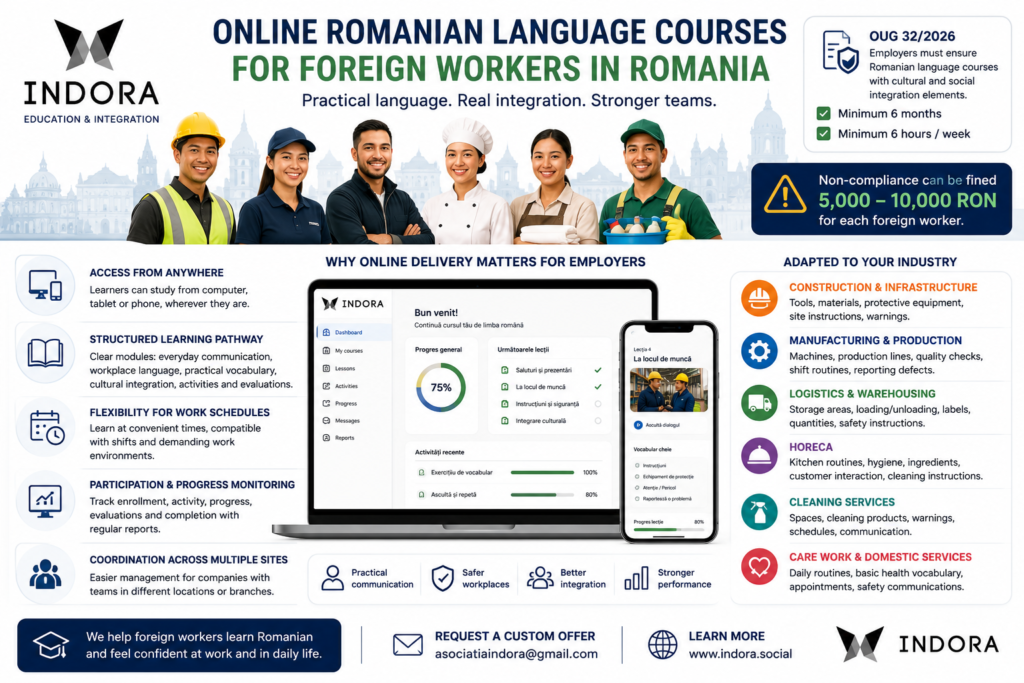
How online learning supports different sectors
An online Romanian course can introduce sector-specific vocabulary and communication scenarios that match the actual work environment. In construction and infrastructure, this means practical vocabulary related to tools, materials, personal protective equipment, on-site instructions, warnings and communication with team leaders. In manufacturing and production, workers may need Romanian connected to machines, production lines, shift routines, quality checks, defect reporting and basic safety procedures. In logistics and warehousing, course content can include storage areas, loading and unloading, quantities, labels, delivery procedures, safety rules and reporting problems.
In HoReCa, relevant language may cover kitchen routines, hygiene requirements, ingredients, customer interaction, cleaning instructions and communication within the team. In agriculture, workers may need vocabulary connected to daily tasks, tools, materials, schedules, safety instructions and communication with supervisors. In cleaning services, useful Romanian may include spaces, cleaning products, warnings, schedules, materials and communication with supervisors or beneficiaries. In care work and domestic services, learners may need language for daily routines, basic health situations, appointments, safety instructions and respectful communication with beneficiaries.
What employers should look for in an online course
Not every online course is suitable for employers who need to organise Romanian language learning for foreign workers. A practical course model should be able to address several important questions. Is the programme structured? Employers should understand the course duration, weekly learning pathway, topics covered and completion criteria. Does it include cultural and social integration? OUG no. 32/2026 refers not only to Romanian language learning, but also to cultural and social integration elements.
Is the content useful in the workplace? Employees should be exposed to practical communication relevant to daily tasks, safety and interaction with colleagues and supervisors. Can the programme fit work schedules? A delivery model should be discussed in relation to shifts, locations and the operational reality of the employer. Can participation and progress be documented? Employers need clarity regarding what information may be provided about participation, activities, progress and completion. Is the course accessible to the actual learners? The course format should take into account workers’ language backgrounds, digital access and learning needs.
Documentation and employer responsibility
Online learning can simplify access and coordination, but employers should still pay careful attention to documentation. In addition to establishing the Romanian language and integration course obligation, OUG no. 32/2026 requires employers to maintain supporting documentation regarding the fulfilment of the relevant obligations under Article 7. For companies, this means that planning should include not only course participation, but also how information is organised and retained.
Depending on the agreed course format, relevant documentation may include participant lists, course structure and duration, participation information, completed activities, progress or evaluation information, completion status, and certificates of participation or completion issued by the course provider. Employers should also seek specialised legal guidance on how the ordinance applies to their particular workforce and what documentation should be retained within their compliance procedures.
How INDORA can support employers
INDORA provides online Romanian language learning designed around practical communication, integration and the real-life needs of foreign citizens in Romania. Our approach is informed by direct work with migrant, refugee and displaced communities and by an understanding of the barriers that foreign learners may face when adapting to a new linguistic, social and professional environment.
For employers and organisations, INDORA can discuss a course format that addresses Romanian language learning for foreign workers, cultural and social integration, practical communication for work and daily life, online access compatible with different schedules, structured learning activities, participation and progress information, documentation according to the agreed programme setup, and sector-relevant vocabulary and communication scenarios. Where relevant to the employer’s needs, the course may be discussed in relation to the 6-month / 6 hours per week structure provided by OUG no. 32/2026.
INDORA may issue certificates of participation or completion for its own courses, according to the agreed criteria. Where an officially recognised language proficiency certificate is required for a particular legal or administrative procedure, the relevant institutional requirements should be verified separately.
Frequently Asked Questions
Does OUG no. 32/2026 require Romanian language courses for foreign workers?
Yes. The ordinance provides that employers hiring foreign workers in Romania must ensure Romanian language courses that include cultural and social integration elements, for at least 6 months from the date the worker starts activity in Romania, as registered in REGES-ONLINE, with at least 6 hours per week.
Can Romanian language courses be delivered online?
An online course format can support a structured and accessible learning pathway, provided that the programme is organised appropriately in relation to the employer’s obligations, learner needs and agreed documentation.
Why is online learning useful for employees working in shifts?
Online access can make learning easier to organise around rotating shifts, multiple locations and demanding operational schedules, while still supporting a structured course pathway.
What can employers monitor in an online course?
Depending on the course setup, employers may receive information regarding participants, completed activities, learning progress, evaluation results and course completion.
Can the course include workplace-specific Romanian?
Yes. Practical vocabulary and scenarios may be adapted to sectors such as construction, HoReCa, production, logistics, agriculture, cleaning services or care work.
Does INDORA issue an officially recognised language certificate?
INDORA may issue certificates of participation or completion for its own courses. If an officially recognised language proficiency certificate is required for a specific procedure, the applicable institutional requirements should be verified separately.
NEED AN OUG 32/2026 COMPLIANT ROMANIAN LANGUAGE COURSE FOR YOUR EMPLOYEES?
Whether you employ foreign workers directly or support companies that do, we can help you organise an online Romanian language and integration course aligned with OUG no. 32/2026.